

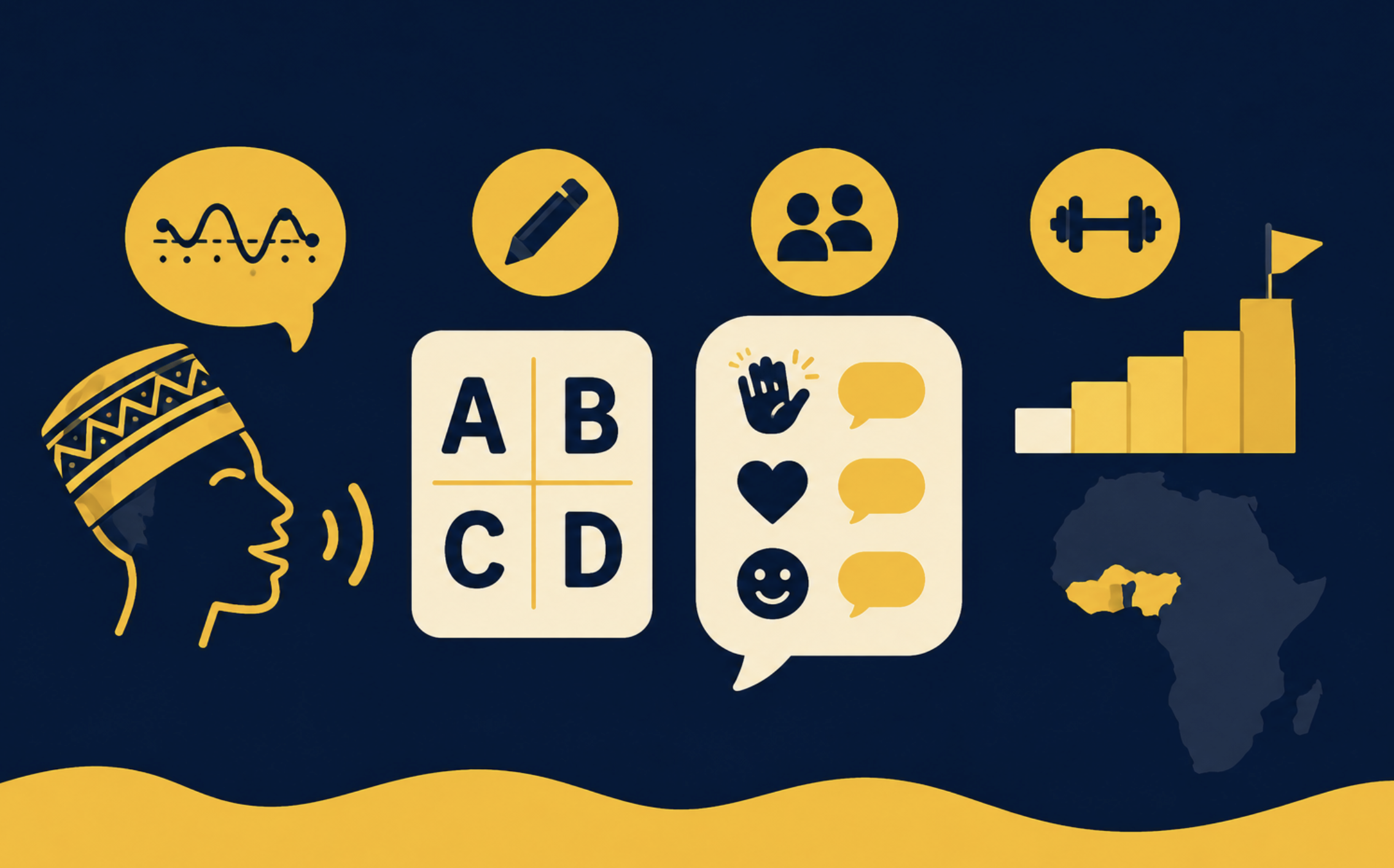
TL;DR: Yoruba is a tonal Niger-Congo language that is spoken primarily across south-
western Nigeria, Benin and Togo, with an estimated number of 45-50 million speakers. The
language has three level tones, marked with accents, and using the wrong one changes a
word’s meaning. The alphabet is a 25-letter Latin alphabet with underdots. Similar to
English, its basic word order is subject-verb-object. There is no grammatical gender and
tense is expressed through separate particles rather than verb conjugation.
Figures for Yoruba speakers vary depending on the source. There are different estimates
available, but the most accurate range is roughly 45-50 million speakers. The language itself
provides unique challenges for learners, particularly with the use of underdots and other
linguistic features.
What is Yoruba and where is it spoken?
Yoruba is a Niger-Congo language spoken primarily across south-western Nigeria and
neighbouring areas of Benin and Togo. Its traditional linguistic region is often called
Yorubaland. However, migration has led to the development of Yoruba-speaking
communities across Nigeria and West Africa.
Yoruba belongs to the Niger-Congo family and it falls within the Yoruboid group and
specifically the Edekiri languages. Older sources sometimes place it in the Defoid
subdivision of Benue-Congo, however this classification is now considered outdated.
Standard Yoruba is based primarily on the Ọ̀yọ́ dialect and provides a shared written form
for things like publishing and education. Memrise teaches Standard Yoruba, starting with a
Basics level that pairs each word or phrase with video of a native speaker pronouncing the
words naturally, as they would be spoken in the real world.
The language also has an important presence outside of West Africa because of the Atlantic
slave trade. Words that are derived from Yoruba remain part of religious traditions, including
Brazilian Candomblé and Umbanda and Cuban Santería.
How many people speak Yoruba?
Depending on the source, estimates of Yoruba speakers range from roughly 20 million to
over 50 million people worldwide. The most current Ethnologue-derived figures put native
speakers at around 48 million and total speakers at 50-53 million.
The lack of consensus reflects the fact that some sources measure only first-language
speakers while others account for second language speakers. Estimates may also count
members of the Yoruba ethnic group rather than people who actively speak the language.
Is Yoruba an official language of Nigeria?
Yoruba is one of Nigeria’s three major national languages. Despite the tens of millions of
people who speak it, the Nigerian constitution does not formally designate Yoruba as an
official language and English remains the principal language of government and
administration.
However, Yoruba does have extensive public and institutional use in south-western Nigeria
and is used in both education and public life. Ethnologue classifies it as a de facto provincial
language at EGIDS Level 2, meaning that the language is used within major institutions.
The Yoruba alphabet
Understanding a separate alphabet is always a challenge for those seeking to learn a
language. Yoruba uses a Latin-based alphabet containing 25 letters. This total counts gb as
a single letter because it represents one sound rather than a sequence of separate g and b
sounds.
The five Latin letters absent from the standard Yoruba alphabet are C, Q, V, X and Z.
However, these letters still appear in names and in English loanwords.
Three letters use underdots. Ẹ represents the open vowel /ɛ/, ọ represents /ɔ/, and ṣ
represents the “sh” sound /ʃ/. Standard Yoruba typography uses dots beneath these letters
rather than short subscript lines.
Meanwhile, the gb sound has no direct English equivalent and is produced by using the lips
and the back of the tongue at almost the same time.
How Yoruba came to be written down
Yoruba has been a written language for longer than most learners assume, and the spelling
used on this page is only about 60 years old.
| Date | Event |
| 17th century | Yoruba written in Ajami, a form of Arabic script. The earliest documented Yoruba text dates from the late 17th century |
| 1840s | Samuel Àjàyí Crowther produces the first Yoruba grammar |
| 1852 | A Vocabulary of the Yoruba Language published in London |
| 1864 | Crowther consecrated at Canterbury Cathedral, the first African Anglican bishop |
| 1875 | Church Missionary Society conference on Yoruba orthography. The standard agreed there held for around 70 years |
| mid-1880s | The complete Yoruba Bible, Bibeli Mímọ́, appears |
| 1965–66 | The current orthography, from Bamgboṣe’s Yoruba Orthography (1965) and the 1966 Orthography Committee report. Underdots replace subscript lines |
Samuel Àjàyí Crowther is a key figure in the history of Yoruba. He was enslaved as a child
and freed by the British navy before receiving an education in Sierra Leone. In 1864 he was
consecrated at Canterbury Cathedral as the first African Anglican bishop. He also wrote the
first grammar of his own language in the 1840s and the vocabulary that followed in 1852.
Tones - the thing that makes Yoruba Yoruba
Yoruba has three level tones: high, mid and low. Tone is not simply a matter of emotion or
emphasis, instead it is an inherent part of the word’s structure. This means that using the
wrong pitch can change the word’s meaning completely, posing a significant challenge for
learners using written textbooks or learning materials.
Tone marks are placed above vowels and syllabic nasal consonants. A high tone takes an
acute accent and a low tone takes a grave accent. The mid tone is usually left unmarked
(although a macron can occasionally be added where clarification is needed).
The University of Georgia’s Yoruba materials teach the three using the solfège scale: low is
do, mid is re, high is mi.
| Tone | Mark | Solfège | Example |
Meaning |
| High |
Acute accent: ó | mi | ró | Tie around the waist |
| Mid | Usually unmarked: o | re | ro | Hoe or farm |
| Low | Grave accent: ò | do | rò | Think |
The clearest way to understand the importance of tone is through minimal sets. These
contain words with the same letters but different tones and meanings.
| Set | Meanings | Source |
| ró / ro / rò | Tie around the waist / hoe or farm / think |
University of Georgia |
| bá / ba / bà | Meet up / hide / strike or hit | University of Georgia |
| sùn / sun / sún | Sleep / roast / move or shift |
University of Wisconsin–Madison |
| eré / Èrè / ère | Play / profit / statue | JPPSS, 2025 |
| igba / igbá / ìgbà | Two hundred / calabash / time or period |
Adesola, Yorùbá grammar sketch |
This is where most learners come unstuck. A page cannot carry pitch, so tone is the one
feature of Yoruba you cannot learn solely from a book. You can learn that ró takes a high
tone and recite the rule perfectly, and still fail to hear it in running speech or produce it in a
sentence. Memrise pairs each Yoruba word with a video of a native speaker saying it, to
help learners differentiate these words.
Whatever you learn from, practise listening early. Tone is the part of Yoruba that gets more
challenging to fix the longer you leave it.
Vowels and consonants
Yoruba has seven oral vowels: a, e, ẹ, i, o, ọ and u.
The underdots distinguish two open vowel sounds. Ẹ is pronounced approximately like the
vowel in “bed”, while ọ resembles the vowel in “thought”. These are separate letters rather
than decorated versions of e and o.
The language also has five nasal vowels: an, ẹn, in, ọn and un. In writing, nasalisation is
normally shown by adding n after the vowel.
There has been disagreement over whether Yoruba has 17 or 18 consonant sounds. The
practical alphabet contains 18 consonant letters. Phonemic analyses sometimes produce
different totals depending on how sounds including gb and h are treated.
Most Yoruba syllables consist of a vowel or a consonant followed by a vowel. Consonant
clusters are not generally used, except where n or m functions as a normal syllable.
How Yoruba grammar works
English learners are usually pleased to find out that the basic Yoruba sentence order is
subject-verb-object, which is broadly the same pattern used in English. A simple statement
normally begins with the person or thing performing the action followed by the verb and then
its object. Yoruba generally requires an expressed subject and it is not normally dropped just
because the listener could infer it, as it can be in English.
Another reassuring feature is that Yoruba verbs do not conjugate for tense, as in Latin
languages like Spanish, French and Italian. Instead, separate particles appear before the
verb to express tense or aspect instead. For example, ń can mark an action in progress,
while ti indicates a completed or prior action. These particles usually sit between the subject
and the verb.
Nouns are also relatively light on inflection. Yoruba has no grammatical gender, unlike
French and nouns are not classified as masculine or feminine. They do not change form for
case and there are no articles directly equivalent to English “a” and “the”. Nouns do not take
plural endings either. Plural meaning is shown through separate words or established by the
wider context.
Yoruba commonly places the noun before words that describe or identify it. Prepositions
come before their complements, broadly matching the familiar English pattern.
Another important aspect to know about the language is that two or more verbs can appear
in the same clause, sharing one subject and describing connected parts of a single event.
Where English might use extra prepositions, conjunctions or separate clauses, Yoruba can
link the actions through a sequence of verbs.
Greetings - a system, not a phrase list
As the University of Georgia’s (UGA) Yoruba materials states: “greetings are inseparable
from the Yoruba, because this is the first thing a stranger will notice.” A greeting registers
respect, acknowledges the other person’s circumstances and holds the relationship in place.
It also runs in every direction, “not only between an elder and a younger one, but also
between peers”. This goes beyond simple politeness and the UGA notes that someone who
passes people on the way without greeting them “is regarded as being untutored”.
The UGA divides Yoruba greetings into four categories:
● Periodic greetings to mark the time of day, and by extension the season.
● Personal greetings to ask after health and wellbeing.
● Situational greetings to acknowledge a circumstance: arrival, travel, illness, recovery,
celebration or bereavement. There are different forms for a death considered
premature and one considered mature.
● Vocational greetings to recognise what someone does. The UGA documents distinct
greetings for farmers, hunters, blacksmiths, traders, teachers, diviners and
hairdressers, among others.
This level of respect is also built into the language. The prefix Ẹ generally signals plural or
formal address and is commonly used when speaking to an elder. This means Káàárọ̀ and Ẹ
káàárọ̀ are related but not interchangeable.
| Yoruba | English | Usage note |
| Ẹ káàárọ̀ | Good morning | Respectful or plural; dawn to around midday |
| Káàárọ̀ | Good morning | Singular or informal |
| Ẹ káàsán | Good afternoon | Around midday to 6pm |
| Ẹ kúùrọ̀lẹ́ | Good evening | Commonly used from around 6pm |
| Ẹ káàbọ̀ | Welcome | Said when someone arrives |
| Báwo ni? | How are you? | Casual |
| Dáadáa ni | I’m fine | Literally “it is well” |
| A dúpẹ́ | We give thanks | A culturally important response about wellbeing |
| Ẹ ṣé | Thank you | Respectful or plural form |
| O ṣé | Thank you | Singular or informal form |
| Ẹ jọ̀wọ́ | Please | Respectful form |
| Ẹ dákun | Please | Alternative form |
| Bẹ́ẹ̀ ni | Yes | Affirmative response |
| Bẹ́ẹ̀ kọ́ | No | Negative response |
| Ẹ má bínú | Sorry | Literally “do not be angry” |
| Kí ni orúkọ ẹ? | What is your name? | Literally asks for the person’s name |
| Orúkọ mi ni … | My name is … | Literally “my name is …” |
| Èló ni? | How much is it? | Useful when buying something |
| Níbo ni … wà? | Where is …? | Used to ask for a location |
| Ó dàbọ̀ | Goodbye | Standard parting phrase |
Body language also feeds into this and the UGA describes boys prostrating, “full stretch with
their chests and chin on the ground”, while girls kneel on both knees. Younger people do not
meet an elder’s eyes: “it is forbidden for the younger ones to look into the eyes of the older
ones.” Meanwhile, the elder will respond by reciting the greeter’s oríkì, the praise and the
names attached to that person and their family.
Counting in Yoruba, and why it is unlike anything you have met
Yoruba counting is much different to anything many English speakers have come across. It
is built around the number 20 rather than ten.
Numbers are formed through a mixture of addition, subtraction and multiplication. This
means counting can feel more like solving a small equation than reciting a sequence.
The key number to learn is ogún, meaning 20 or one score. Forty is ogójì, constructed as
two 20s. One hundred is ọgọ́rùn-ún, or five 20s, while igba means 200.
The numbers from one to ten are:
ení or ọ̀kan, èjì, ẹ̀ta, ẹ̀rin, àrún, ẹ̀fà, èje, ẹ̀jọ, ẹ̀sán, ẹ̀wá.
The system becomes especially interesting when approaching the next multiple of ten or 20.
Numbers ending in one to four are generally formed by addition. Those ending in five to nine
are often constructed by subtracting from the next major number. The element -dín- means
“less”.
For example:
| Number | Yoruba | Logic |
| 15 | ẹ̀ẹ́dógún | 20 − 5 |
| 16 | ẹ̀rìndínlógún | 20 − 4 |
| 17 | ẹ̀tàdínlógún | 20 − 3 |
| 18 | èjìdínlógún | 20 − 2 |
| 19 | ọ̀kàndínlógún | 20 − 1 |
| 20 | ogún | Landmark |
| 30 | ọgbọ̀n | Landmark |
| 40 | ogójì | 20 × 2 |
| 100 | ọgọ́rùn-ún | 20 × 5 |
| 200 | igba | Landmark |
The result is a counting system that reflects relationships between quantities rather than
simply attaching one digit to another.
Is Yoruba hard to learn?
It depends on which half of the language you mean. While grammar is easier than the
equivalent stage of French or German, the tones in Yoruba are harder than English.
There is no reliable official estimate of how many hours it takes to learn Yoruba. The US
Foreign Service Institute (FSI) has never assigned Yoruba to one of its language-difficulty
categories. The only African languages FSI does rate are Swahili at 900 hours and Amharic,
Xhosa and Zulu at 1,100. MustGo puts it most cleanly and honestly, in that: “There is no
data on the difficulty of Yoruba for speakers of English.”
The FSI has produced a substantial Yoruba Basic Course containing tone drills and 49
teaching units. Its own materials describe accurate perception and production of tone as the
greatest difficulty.
Yoruba has no grammatical gender or noun cases. Nouns do not take plural endings and
verbs do not conjugate for person or tense. Time and aspect are usually expressed through
separate particles placed before the verb.
Tone is the harder part of the language to learn. Learners must hear and reproduce three
meaningful pitch levels while also paying attention to unfamiliar vowels and sounds, like gb.
A word pronounced with the wrong tone may actually have a notably different meaning.
Is Yoruba an endangered language?
UNESCO has never predicted that Yoruba will become extinct. Current language data does
not classify it as endangered.
The “extinct by 2025” claim was never about Yoruba. Punch, on 12 January 2020, reported
that “in 2006, UNESCO reportedly predicted the Igbo language spoken in the South-East
Nigeria by over 20 million people may become extinct in the next 50 years”. This references
Igbo, not Yoruba.
The claims aimed specifically at Yoruba come from Nigerian public figures rather than any
international body. Punch attributed a prediction of “20 years or less” to a language teacher,
Dahunsi Akinyemi, in 2017. Vanguard’s March 2022 piece “Is the Yoruba language, culture
going extinct?” quotes the Oyo State Government, the Deji of Akure and a number of Yoruba
cultural advocates.
However, this does not detract from the underlying concern. Fabunmi and Salawu wrote in
the Nordic Journal of African Studies in 2005, in a paper titled “Is Yorùbá an Endangered
Language?”. They argue that “the largeness of the percentage of the speakers of the
language cannot thwart the supplantive moves of language endangerment”, and note that
Nigeria’s mother-tongue-education principle has “never been implemented in the country”.
Frequently asked questions
How many people speak Yoruba?
Estimates range from roughly 20 million to over 50 million. The most current Ethnologue-
derived figures, quoted by Wikipedia, put native speakers at around 48 million and total
speakers at 50-53 million. Lower figures are almost always from older studies and sources,
as Ethnologue’s own free page still shows 19.0 million from a 1993 survey.
Is Yoruba hard to learn?
There is a clear division between Yoruba grammar and pronunciation. The grammar is
easier than most European languages, with no grammatical gender, no noun cases, no
plural endings and no verb conjugation. Additionally, tense is conveyed by particles before
the verb. However, the tones used by Yoruba make this a difficult language to speak. There
are three different pitch levels, and using the wrong one can change the meaning of a word
entirely.
How many tones does Yoruba have?
There are three tones in Yoruba: high, mid and low. High takes an acute accent, low takes a
grave accent, and mid is normally left unmarked, with an optional macron where a word
would otherwise be ambiguous. Rising and falling contours do occur, and some pages count
them as a fourth and fifth tone
Is Yoruba an official language of Nigeria?
Yoruba is not Nigeria’s official language. Nigeria’s constitution does not designate an official
language at all, and English is the language of government and national administration.
Section 55 of the 1999 Constitution names Hausa, Ibo and Yoruba as languages in which
National Assembly business may be conducted “when adequate arrangements have been
made therefor”. That is a procedural rule rather than a declaration of status. However,
Yoruba remains one of Nigeria’s three major national languages, and Ethnologue classifies it
as a de facto provincial language of the south-west.
Why do some Yoruba letters have dots underneath?
The dot marks a different sound, not a decoration. Ẹ is the open vowel /ɛ/, close to the vowel
in “bed”. Ọ is /ɔ/, close to “thought”. Ṣ is the “sh” sound /ʃ/. Each is a separate letter of the 25-
letter alphabet, so ẹ and e are no more interchangeable than b and p, and dropping a dot
changes the word. Standard practice has used dots rather than subscript lines since 1966.
Is Yoruba going extinct?
No, UNESCO has never predicted Yoruba’s extinction and Ethnologue rates it as EGIDS
Level 2, “Provincial”, meaning a vigorous language used in education, administration and
media. The viral “extinct by 2025” claim is misquoted from a 2006 report about Igbo rather
than Yoruba.
Is Yoruba the same as the Yoruba religion?
No, Yoruba is a language of roughly 45-50 million speakers, and also the name of an ethnic
group and a region, Yorubaland. The Yoruba religious traditions of Ifá divination and Òrìṣà
worship are practised in the language but are not the language. Yoruba speakers are
variously Muslim, Christian and practitioners of traditional religion.
How long does it take to learn Yoruba?
There is no official estimate for learning Yoruba and the US Foreign Service Institute has
never assigned Yoruba a difficulty category or an hour count. MustGo states plainly that
“there is no data on the difficulty of Yoruba for speakers of English.” The nearest FSI-rated
comparators are Swahili at 900 hours and Zulu and Xhosa at 1,100, which provide an order
of magnitude at best. FSI’s own Yoruba Basic Course ran to 49 units.