

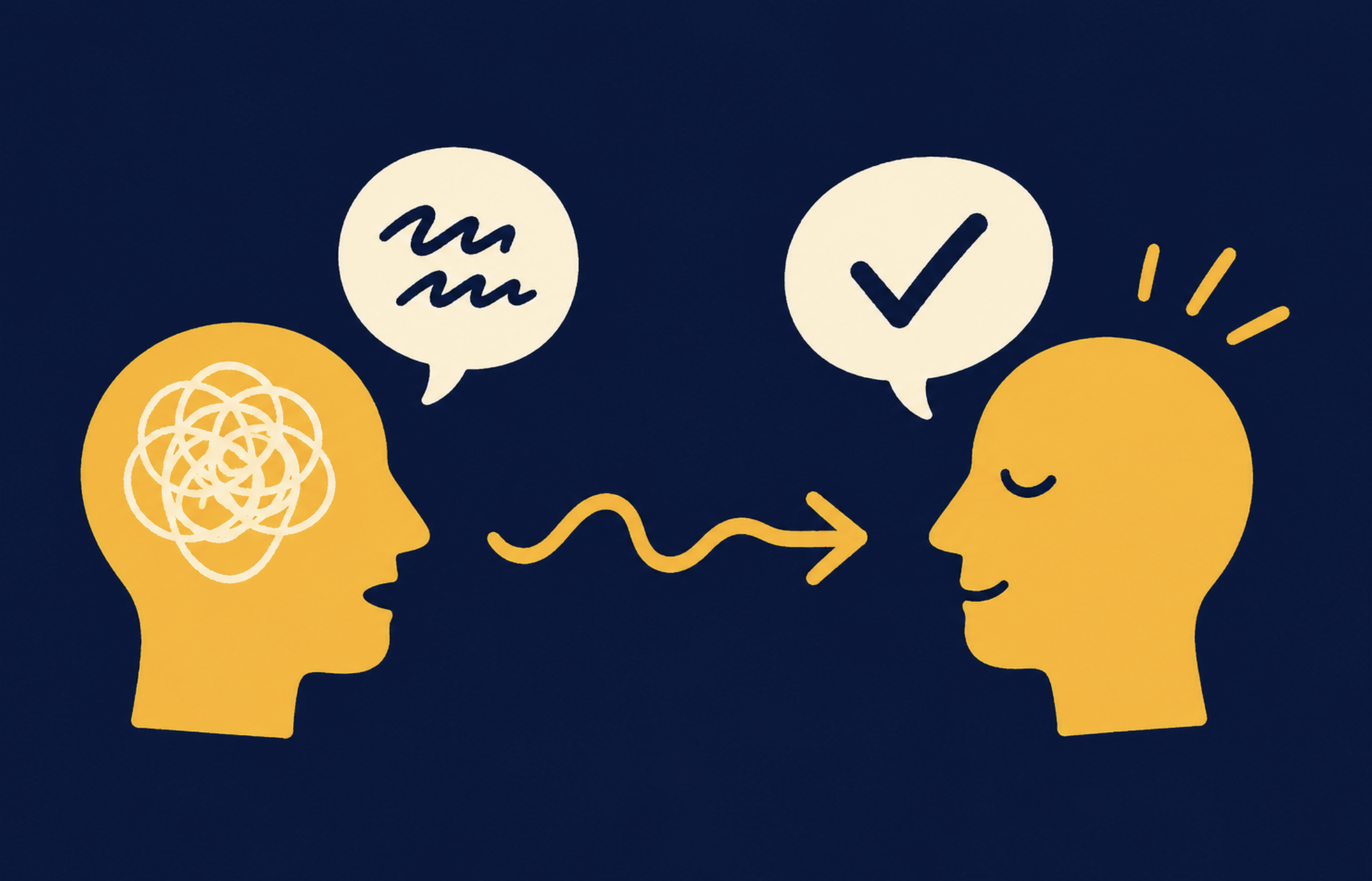
TL;DR: Reading and listening help you develop recognition skills to understand a language,
but speaking requires you to recall vocabulary, construct sentences, and respond in real
time. The gap between understanding a language and speaking it reflects how these skills
develop and does not showcase a lack of progress. Learners can close the gap by speaking
regularly, practising active recall, and hearing authentic conversations.
If you can understand a language but can’t speak it, you’re not doing anything wrong. It is a
common gap that most learners have to work through at some point. Luckily, there are
practical ways to help you speak a new language more quickly.
Why can I understand a language but not speak it?
Understanding and speaking rely on different language skills. Your brain does a simpler job
when you listen or learn: it recognises words, interprets them, and understands meaning.
With speaking, however, your brain has to do the opposite: retrieve vocabulary, organise it
into thoughts, apply grammar to it, and pronounce it clearly.
Speaking is, therefore, one of the most demanding language skills. Many learners develop
listening and reading faster than speaking and writing. Batia Laufer tracked 48 school-age
learners of English for a year and reported in Applied Linguistics in 1998 that their passive
vocabulary progressed well over that year while their free productive vocabulary did not
progress at all. Recognising a word before you can produce it is the normal order of
development, not a sign that a learner is doing anything wrong.
Understanding a new language shows that your knowledge is growing. The challenge is
accessing the knowledge quickly enough to use it in a conversation. This should happen
within seconds so that you can engage with other people.
What’s the difference between recognising a word and producing it?
Recognising a word is easier than recalling it from memory. Imagine talking to someone, and
they ask you to say the Spanish word biblioteca. Spanish learners will almost instantly
recognise the word and associate it with its meaning: ‘library’. Your brain works to match
something you’ve heard with what you already know.
What if someone asks you what the word for library is in Spanish? In this case, the same
task seems completely different and slightly challenging. Instead of recognising the answer,
your brain has to retrieve it without a prompt.
Psychologists often describe this as the difference between recognition memory and recall
memory. Recognition gives you clues that help in identifying the correct answers. Recall
expects you to produce the right answer independently, making it more demanding.
Language learners encounter this problem constantly. You may find it easy to understand a
podcast, follow a television programme, and understand a teacher’s questions. However, it
is challenging to answer those questions yourself. This does not mean that you have
forgotten the language; it’s just that recall is harder than recognition.
Why does speaking feel slower than listening?
Speaking, unlike listening, requires several mental processes to happen almost
simultaneously. You have to perform so many things to speak and participate in a
conversation. This includes the following:
● Decide what you want to communicate
● Find the right words
● Apply grammar
● Choose appropriate pronunciation
● Monitor your speech
● Listen to the other person’s response
Native speakers find repeating this pattern easy because they have practised over many
years. These individuals perform these steps automatically because they have built the
connections. Language learners are still trying to grasp the connection, and speaking will
take time.
Developing fluency is largely about reducing the mental workload through repeated use. The
more you struggle to speak, the more you improve. Your brain becomes used to retrieving
information quickly and transforming it into speech.
How can you become more confident speaking a language?
Speaking becomes easier once you make it a regular part of your learning. It is not
something you save until the very end of your programme. Many learners delay speaking
because they believe they need to learn more words first.
Learners should start practising speaking after learning a few words. This helps develop
their confidence through experience, not preparation alone. The goal is to become
comfortable expressing ideas and not producing perfect sentences.
You can start with simple tasks like introducing yourself, describing your day, and talking
about hobbies. These activities feel basic but train your brain to retrieve vocabulary when
needed. You will slowly stop relying on written prompts when you start speaking early.
You can also practise active recall by challenging yourself to produce words from memory.
For instance, cover the translation and say the word aloud, or describe a picture without
looking up vocabulary. Each successful retrieval strengthens your ability to access that
vocabulary during real conversations.
Memrise lets you pause after listening to a native speaker use a phrase naturally. This gives
you time to repeat it aloud while paying attention to rhythm and pronunciation. This
technique, referred to as shadowing, helps learners become more comfortable producing
natural speech patterns over time.
How do listening, vocabulary, and speaking work together?
Language skills support one another rather than develop independently. The table below
illustrates how different types of practice contribute to speaking confidence
| Learning activity | What it develops | How it supports speaking |
| Listening to native speakers | Comprehension, pronunciation, and rhythm |
Makes natural speech easier to recognise and imitate |
| Vocabulary review | Word knowledge | Provides the building blocks for conversations |
| Active recall | Memory retrieval | Improves your ability to access words quickly |
| Reading | Grammar, sentence patterns, and vocabulary |
Reinforces structures you can later use in speech |
| Speaking practice | Fluency and confidence | Strengthens recall through repeated production |
| Feedback and correction | Accuracy | Helps refine pronunciation and grammar over time |
No single activity can work on its own when learning a new language. Most confident
speakers combine reading, listening, vocabulary review, and speaking to create a balanced
routine. Each reinforces the others, making communication feel increasingly automatic.
Many learners benefit from practising with authentic speech rather than relying on written
exercises only. Hearing real people having conversations in real time strengthens the
connection between recognition and production. Memrise supports this by combining
vocabulary review with videos of native speakers.
Frequently asked questions
Does speaking improve faster than listening?
Usually not, in fact, listening improves faster than speaking for most learners. Listening only
asks you to recognise language that is already in front of you, while speaking asks you to
retrieve it from memory, order it, and pronounce it under time pressure. Expect to
understand listening before your speaking skills develop, and treat it as a normal stage
rather than a plateau.
What’s the best way to practise speaking by yourself?
Speaking aloud every day, recording yourself, describing your surroundings, retelling stories,
and reading short texts. These are independent activities that introduce you to the
conversational environment. They strengthen active recall and help make familiar vocabulary
easier to retrieve when speaking.
Do native-speaker videos help improve speaking?
Yes. Video footage of real speakers gives you the pronunciation and everyday phrasing that
scripted studio audio tends to take away, so you hear how the language is actually spoken
rather than how it is written. It also gives you something definitive to copy: pause the clip,
repeat the phrase and match the speaker's pace. That imitation is what turns recognition
into fluency.
Why do I keep translating in my head?
Translating in your head is a normal stage, not a bad habit. Early on, the route from an idea
to a word runs through your first language, because that is the only pathway you have built.
As you meet the same words repeatedly in speech and then start to use them yourself, the
direct link strengthens and you can start recalling phrases without too much extra thought.
Can adults become fluent in another language?
Yes. Adults learn languages successfully throughout their lives, and what separates the
adults who reach fluency from those who stall is usually how much they practise, how much
real speech they hear, and how often they get to use the language with other people. Adults
also start with advantages children do not have: they can study grammar deliberately and
transfer strategies from a language they already speak.