

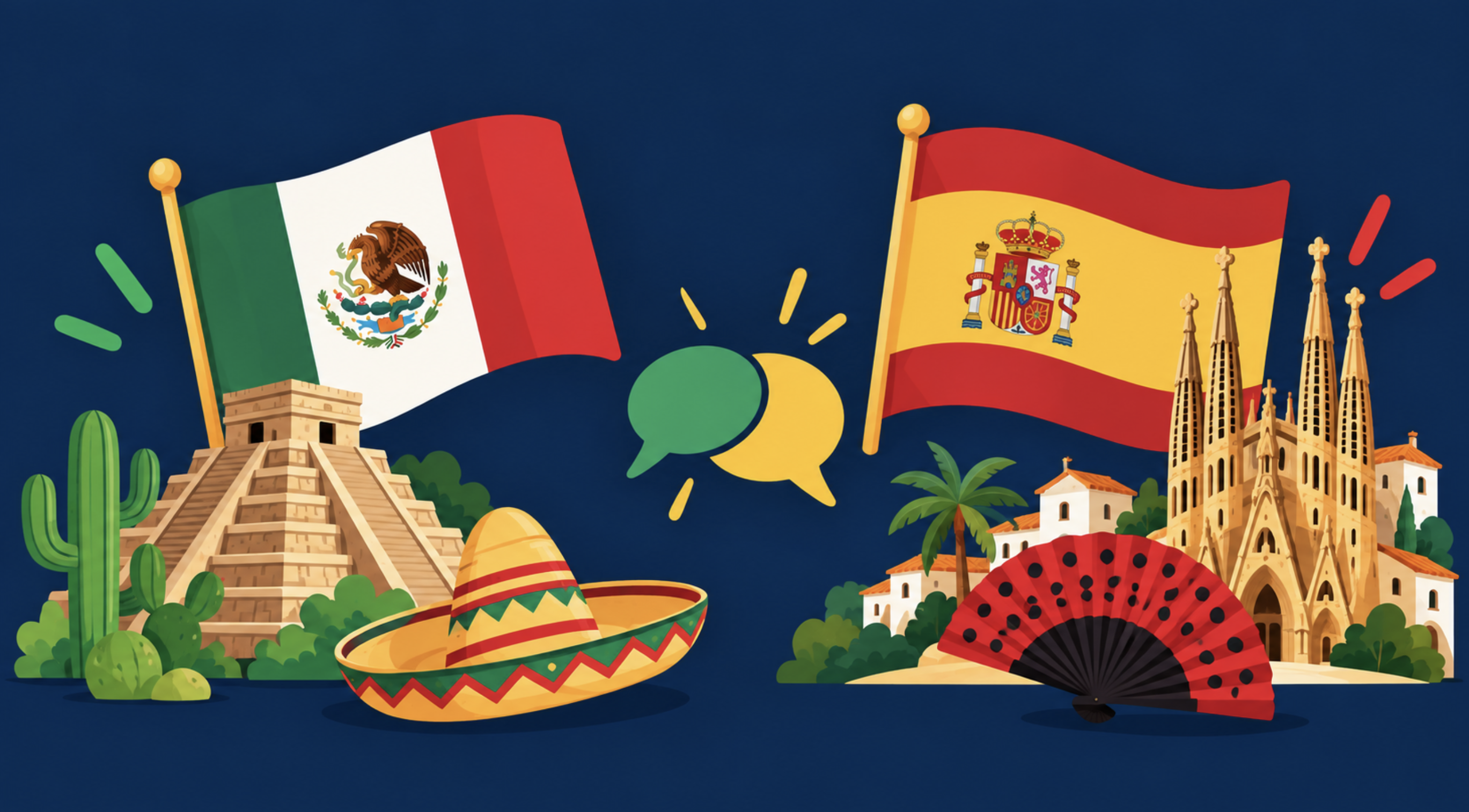
TL;DR: While Mexican Spanish and Spain Spanish are varieties of the same language, they differ in pronunciation, vocabulary, and some grammar. The clearest example is the plural form of you, which is vosotros in Spain and ustedes in Mexican Spanish. Vocabulary also varies, with words such as a computer translated as computadora in Mexico and ordenador in Spain. Both varieties remain mutually understandable, but learners may notice different accents, expressions, and verb forms.
This guide sets out the differences that actually affect a learner: the c and z pronunciation split, the softer Mexican j, the vosotros and ustedes divide with its separate verb endings, and a table of the everyday words that change. These examples include computadora and ordenador, celular and móvil, jugo and zumo. The article closes with a discussion on how to choose between the two varieties to learn.
Is Mexican Spanish the same as Spain Spanish?
Mexican Spanish and Spain Spanish share the same core language but have distinct regional features. The difference is often heard in everyday speech and seen in vocabulary and grammar. The Royal Spanish Academy (RAE) notes that Spanish has substantial regional lexical variations while also sharing a large common vocabulary across Spanish-speaking communities.
Learners who understand Mexican Spanish can communicate in Spain, while those accustomed to Spain Spanish can communicate in Mexico. However, a few words and grammatical forms will sound unfamiliar or unusual depending on the variety. This makes it important to use a language app like Memrise, which offers learners the different varieties of Spanish.
How is pronunciation different between Mexican Spanish and Spain Spanish?
One of the most noticeable differences between Mexican Spanish and Spain Spanish is pronunciation, particularly with the letters c (before e or i) and z. In much of Spain, these sounds are pronounced with the “th” sound found in the English word “think”. For example, cinco and zapato have this pronunciation in most of Spain. In Mexican Spanish, these sounds are pronounced like the “s” in the English word “see”. Therefore, cinco and zapato use an “s” sound.
There is also a difference in the pronunciation of the letters g (before e or i) and j. In Spain, these sounds are pronounced with a stronger and throatier sound. In Mexico, however, the sound is softer and less guttural.
Do Mexico and Spain use different words ?
Yes, some everyday object and concepts have different names in Mexican and Spain Spanish. This can include the following:
| English | Mexican Spanish | Spain Spanish |
|
Computer |
Computadora |
Ordenador |
| Mobile phone | Celular | Móvil |
|
Waiter |
Mesero | Camarero |
|
Car |
Carro/coche | Coche |
| Glasses | Lentes | Gafas |
|
Bus |
Camión | Autobús |
|
Juice |
Jugo | Zumo |
|
Apartment |
Departamento | Piso |
|
To rent |
Rentar | Alquilar |
Not every Mexican or Spanish speaker uses the same vocabulary. Learners will, therefore, find some shared words and some different words. Regional vocabulary can also change within Spain and Mexico.
Language-learning apps like Memrise introduce learners to key differences early. This is especially helpful because some familiar Spanish words can have different everyday equivalents depending on where the speaker is from.
| English | Mexican Spanish | Spain Spanish |
|
You all speak |
Ustedes hablan |
Vosotros habláis |
| You all eat | Ustedes comen | Vosotros comeís |
|
You all live |
Ustedes viven | Vosotros vivís |
Individuals learning Spain Spanish should become accustomed to learning vosotros. This is because it is a normal part of everyday conversation in Spain. Similarly, those learning Mexican Spanish should learn ustedes because it is commonly used in that region.
Frequently asked questions
Should you learn Mexican or Spain Spanish?
Choose a variety that matches where you expect to use Spanish more often. Mexican Spanish is helpful when your main conversations will be with people in Mexico or communities that use Mexican Spanish. Spain Spanish is equally useful when you expect to live, study or communicate primarily in Spain.
Can Mexicans understand people from Spain?
Yes, speakers of Mexican and Spain Spanish can generally understand each other despite regional differences. Communication is possible because the two varieties have a common grammatical foundation. Differences are noticeable in regional slang, specialised vocabulary, fast speech, and unfamiliar accents.