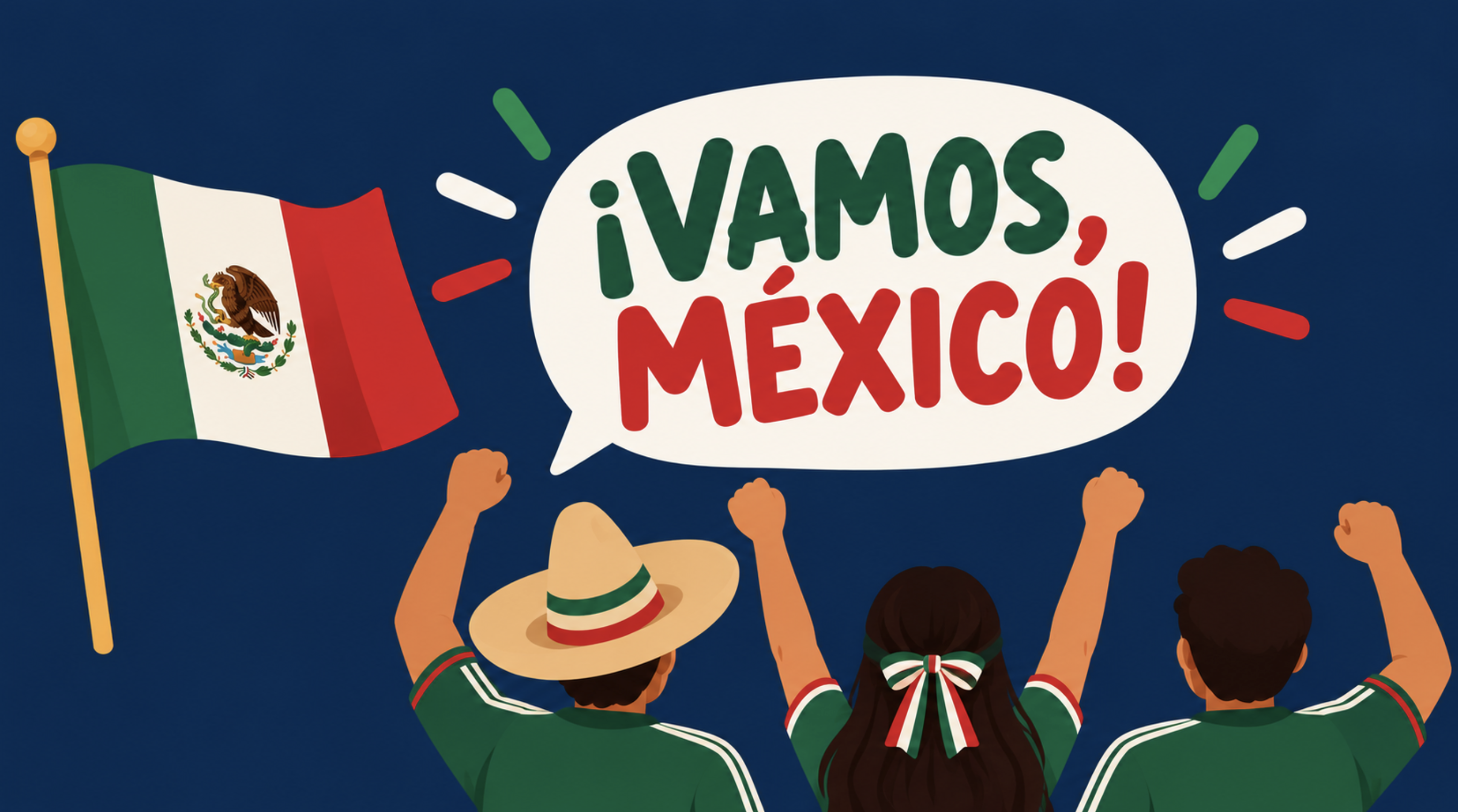
TL;DR: 'Let's go, Mexico!' is '¡Vamos, México!' in Spanish, with a comma because you are speaking to Mexico directly. Vamos comes from the verb ir (to go) and works as both 'let's go' and 'come on'. Use '¡Vámonos!' when you mean 'let's leave', and 'Vamos a México', with the preposition a, when you mean travelling there. To add to the cheer, use '¡Sí se puede!' or '¡Viva México!'
This guide covers the direct translation and why it takes a comma, the two jobs '¡Vamos!' does in everyday Spanish, how '¡Vámonos!' differs, and the other cheers you will hear at a Mexico match. One caveat up front: banners and social media posts often drop the comma, but written Spanish still requires it, so don’t be mislead when you read it in advertising.
How do you say "Let's go, Mexico! in Spanish?
The most direct translation for ‘Let’s go, Mexico!’ in Spanish is ‘¡Vamos México!’ In this situation, ‘vamos’ is the first-person plural form of ‘ir’ (the Spanish verb meaning ‘to go’). It can correspond to ‘we go’ or ‘let’s go’, depending on the sentence.
The comma matters because ‘¡Vamos México!’ addresses Mexico directly. It can, therefore, work as a cheer, slogan, or enthusiastic call directed towards Mexico. For example:
- ¡Vamos México! - Let’s go, Mexico!
- ¡Vamos México! ¡Tú puedes! - Let’s go, Mexico! You can do it!
- ¡Vamos! - Let’s go!
The phrase is straightforward when intended to encourage or cheer for Mexico. It is a common expression that language learners may encounter, especially when watching a sporting event.
What does '¡Vamos!' mean in Spanish?
‘¡Vamos!’ translates to ‘Let’s go!’ in Spanish. However, the meaning often changes slightly with context. It can be used to either encourage someone to leave or continue with a specific action. Here are examples in sentences with the two different meanings:
- ¡Vamos, tenemos que irnos! - Let’s go, we have to leave!
- ¡Vamos, tú puedes! - Come on, you can do it!
Therefore, ‘¡Vamos!’ can have two different meanings depending on the situation. Learners using language apps like Memrise are introduced to these situations early through AI conversations. This helps them learn to effectively use the word in real-life conversations.
What does '¡Vámonos!' mean?
‘¡Vámonos!’ is another common way to say ‘Let’s go!’ in Spanish. It comes from the verb ‘irse’, meaning ‘to leave’ or ‘to go away’. This distinction is helpful for learners who are getting started with Spanish.
'¡Vámonos!' is vamos with the pronoun nos attached (the final s drops), which is why it implies the sense of leaving: everyone, including the speaker, is setting off together. '¡Vamos!' is broader and can mean 'come on' as well as 'let's go'. In a stadium you will hear '¡Vamos!'; at the end of a night out, '¡Vámonos!' is more likely.
| Spanish | Approximate English meaning | Typical use |
|
¡Vamos! |
Let’s go! / Come on! |
Going, encouraging, continuing |
|
¡Vámonos! |
Let’s go! / Let’s leave |
Leaving or setting off |
|
¡Vamos, México! |
Let’s go, Mexico! |
Encouraging or cheering for Mexico |
|
Vamos a México |
Let’s go to Mexico / We’re going to Mexico |
Describing a trip to Mexico |
|
Vámonos, que se hace tarde |
Let’s go, it’s getting late |
Asking someone to leave with you before you get behind schedule |
How do you cheer for Mexico in Spanish?
When cheering for Mexico, ‘¡Vamos, México!’ is the most natural expression. However, you can add short phrases of encouragement depending on the situation. Here are a few examples:
- ¡Vamos, México, sí se puede! - Let’s go, Mexico, yes, we can do it!
- ¡Viva México! - Long live Mexico!
- ¡Fuerza, México! - Stay strong, Mexico!
Cheers are easy to read and hard to catch at full volume, especially '¡Sí se puede!', which a crowd runs together almost into one word. Memrise's Mexican Spanish course includes a phrasebook entry for 'let's go', so you can hear how a native speaker says it before trying it in a crowd.
However, learners should understand that the phrase ‘¡Viva México!’ has a different meaning from ‘¡Vamos, México!’ It is an expression of celebration or support rather than a literal call to go somewhere.
Is '¡Vamos, México! correct without a comma?
When addressing Mexico directly, the correct format should include the comma. The comma is an important inclusion that separates ‘vamos’, the expression of encouragement, from México, the person or thing being addressed.
The construction is different when a speaker intends to go to Mexico. In this case, the correct phrase would be ‘Vamos a México’, which translates to ‘Let’s go to Mexico’. The preposition ‘a’ is an essential component because it introduces the destination.
Frequently asked questions
What does ‘¡Vamos, México!’ mean?
The phrase ‘¡Vamos, México!’ means ‘Let’s go, Mexico!’ and is generally an expression of encouragement towards Mexico. It is a common phrase because it can be used as a cheer during a sporting event or in another situation where someone is supporting Mexico. This makes it a helpful phrase for learners to master when learning Spanish.
Is ‘¡Vámonos!’ the same as ‘¡Vamos!’?
While both can mean ‘Let’s go!’, ‘¡Vámonos!’ more specifically suggests leaving or setting off. It also makes the statement feel more personal and direct, as if the speaker is pulling the listener along with them. By contrast, ‘¡Vamos!’ has a broader range of uses and can also mean ‘Come on!’ or encourage someone to continue.