

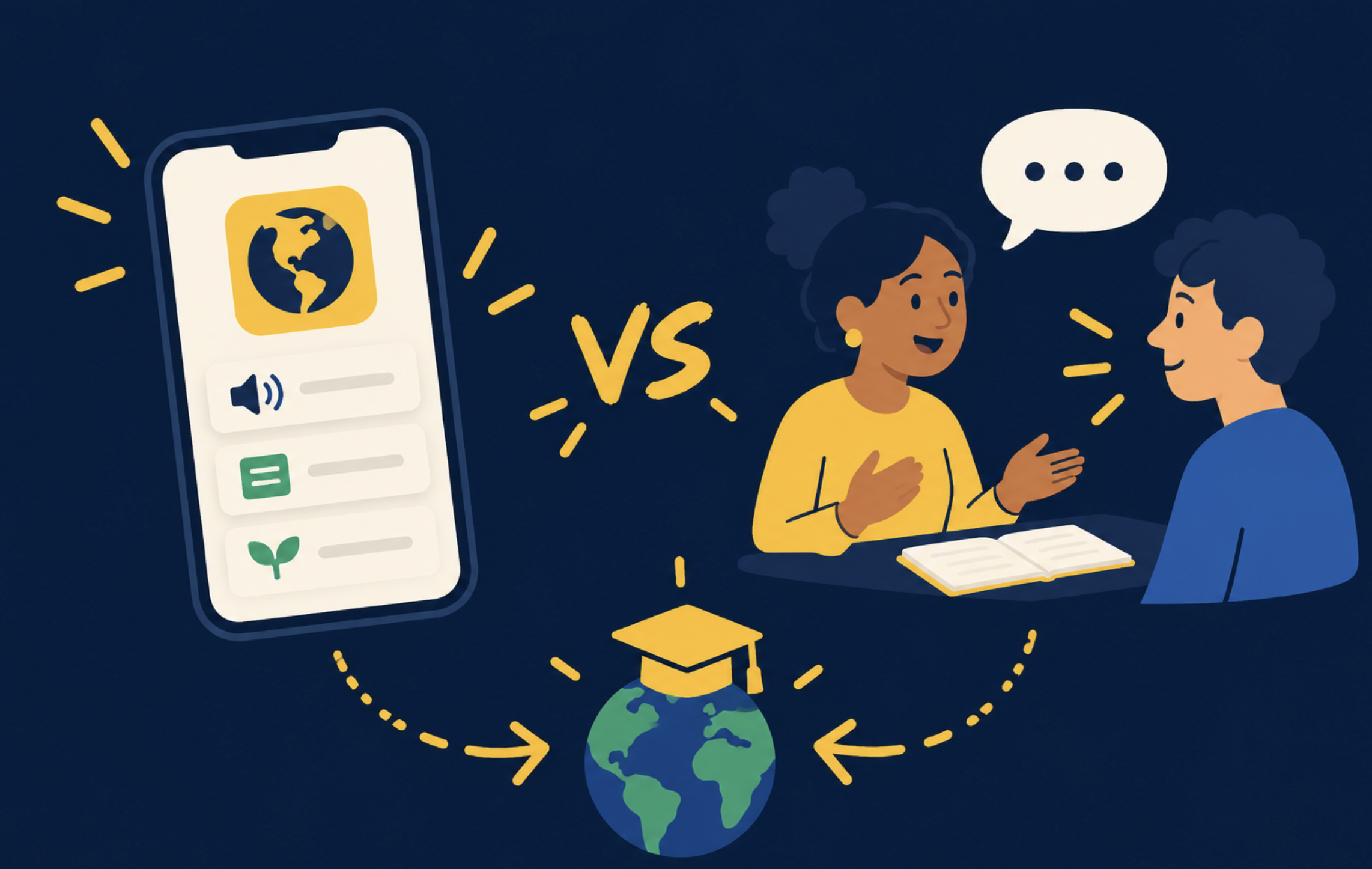
TL;DR: Neither a language app nor a tutor guarantees fluency on its own. Apps are strong
on structured practice, vocabulary review and listening, and they are cheaper and available
whenever you are. Tutors are strong on personalised feedback and unscripted conversation,
which is the part most learners are missing. Combine the two if your goal is to communicate
confidently: an app for regular independent practice, a tutor for interaction and correction.
If you’ve spent months using a language app but still have trouble speaking, it is reasonable
to wonder whether you need a tutor. The opposite can also happen when you have regular
tutor lessons but struggle to remember vocabulary between sessions. You can always use
both options to solve different parts of the language-learning problem.
What can a language app actually teach you?
A language app, like Memrise, offers a structured approach to learning vocabulary,
grammar, pronunciation and listening. Learners don’t need to schedule a lesson with another
person, allowing them to learn on their own time. This approach is particularly useful for
beginners who need to build a basic vocabulary and become familiar with common sentence
patterns.
Apps also make repetition easier. Instead of deciding what to revise each day, learners can
use built-in review systems to revisit previously studied material. This helps learners improve
their fluency because they can always retrieve and reuse vocabulary. Jeffrey Karpicke and
Henry Roediger reported in Science in 2008 that students who kept retrieving 40
Swahili–English word pairs recalled about 80% of them a week later, against 36% for those
who kept restudying them instead.
Language-learning apps offer convenience for learners who struggle to maintain
consistency. A short study session can fit around work, school and travel. App users get
more practice within a short period.
What can a tutor do that an app cannot?
A tutor can listen to you, identify where you’re having trouble and adjust the lesson
accordingly. They can address any grammatical errors that you seem to repeat consistently.
Once you understand a particular topic, they can move on to the next section and adjust the
difficulty level.
A tutor can help the learner by creating a genuine two-way mode of communication. The
learner can listen to the instructions, decide what the tutor means and formulate a suitable
response. This combination closely resembles the demands of an actual conversation.
Tutors can also give real-time, specific feedback. They can correct pronunciation, suggest a
more natural expression or explain why a sentence sounds unusual even when grammatically understandable. An app can provide feedback on predefined exercises, but it cannot necessarily interpret the full meaning of an unexpected response the way a skilled teacher can.
Which is better for building vocabulary?
Learning apps offer a practical advantage over tutors when it comes to independent
vocabulary practice because they make repetition convenient. You don’t need to wait for the
next lesson to review words and learn new vocabulary. Systems based on spaced repetition
can also help organise reviews so that previously learned vocabulary returns at intervals
rather than disappearing from your study routine.
A tutor, however, can always show the learner which vocabulary is worth learning and how
to use the new words in context. Consider the difference between knowing a translation and
knowing how to use a word naturally. Tutors have experience and can explain whether an
expression is formal, informal, outdated, or unusual in a particular context.
Here is a breakdown of the differences between learning apps and tutors for building
vocabulary:
| Learning need | App | Tutor |
| Regular vocabulary review | Strong | Limited by lesson schedule |
| Spaced repetition | Often built in | Usually requires separate materials |
| Personalised feedback | Limited | Strong |
| Spontaneous conversation | Limited | Strong |
| Flexible study time | Strong | Depends on availability |
| Pronunciation correction | Varies by app | Strong |
| Accountability | Built into some apps | Strong through scheduled lessons |
| Exposure to different native speakers |
Available on some platforms | Depends on tutor |
The table illustrates that you can use both a learning app and a tutor to improve your
vocabulary. Each option addresses different learning needs to help you become fluent in
your chosen language.
Does using an app mean you don’t need a tutor?
Not necessarily. A learning app provides a strong foundation, but whether you need a tutor
depends on your goals. Independent study through the app may be enough when you are
learning basic phrases.
Whether to use a learning app alone also depends on your current level. Beginners may
benefit from the structure and repetition of an app, while an intermediate learner who
understands but cannot sustain a conversation may get more value from targeted speaking
practice.
The important question is not whether an app can replace every function of a tutor. It is
whether the tool you are using gives you enough practice for the specific skill you want to
develop. Apps like Memrise include a spaced repetition system that helps you remember
words better by reviewing them at the right times.
Is a language tutor worth the cost?
While a tutor can be worth the cost because they offer personalised feedback, paying for
lessons does not automatically produce fluency. The main advantage is spending more time
actively using the language with another person. Tutors identify recurring mistakes and
adapt the lessons to your level, creating conversations that require responses without relying
on prepared answers.
There is also an accountability benefit when working with a tutor. A scheduled lesson
creates a commitment that an independent study session may not. This external structure is
particularly useful for learners who frequently postpone practice.
However, tutoring has a practical limitation: the learning largely occurs during scheduled
times and learners can find it difficult to continue practising independently. A weekly lesson
cannot replace regular exposure to vocabulary, listening and reading.
This is where an app complements a tutor. Independent practice between lessons gives you
more opportunities to review vocabulary. You can consistently encounter the language while
the tutor provides feedback and interaction that an app cannot fully reproduce.
Can a language app make you fluent without a tutor?
An app can support substantial language development, but there can be no promise that
completing a course will make every learner fluent. Fluency is difficult to reduce to a single
measurable outcome. Someone may understand conversations well but write slowly, read
comfortably but struggle to speak, or communicate effectively despite making grammatical
mistakes.
What matters is whether your learning routine gives you opportunities to develop the skills
you actually need. Apps combine vocabulary learning with videos featuring native speakers
to help make you fluent. Learners using them are exposed to natural speech alongside their
independent study.
The limitation is that watching somebody speak is not the same as having to respond to
them. If you want to engage more in conversations, you will need to produce language
yourself.
Frequently asked questions
Is a language app better than a tutor?
Neither is better in general; they are better at different things. Apps win on frequency and
cost allowing you to practise vocabulary daily, review on a schedule and fit sessions around
work. Tutors win on interaction: they hear your specific mistakes, correct pronunciation in
real time and make you respond to something you did not prepare for. If you can only pick
one, pick the one that covers the skill you are weakest at.
Can I become fluent using only a language app?
Possibly, depending on what you mean by fluent. An app can carry vocabulary, grammar,
listening and reading a long way, but it cannot promise fluency, because conversational
fluency needs chances to understand and produce language in real situations. Most learners
who get there using an app alone add something conversational as well, such as a language
exchange, a conversation group or time in the country.
Do I need a tutor to learn a new language?
No. Plenty of learners get a long way using apps, books, audio, video and conversation
partners alone. A tutor earns their cost when you need structured speaking practice or when
you keep repeating the same mistakes and need somebody to correct you. Whether one is
worth it depends on your goals and your budget, making this a question of value, not
necessity.
Are language apps good for speaking?
Language apps support speaking development, particularly through pronunciation exercises,
listening activities and prompts that require learners to produce language. However,
spontaneous conversation involves responding to another person in real time. While apps
offer native speaker videos, they cannot replicate this level of genuine interaction.