

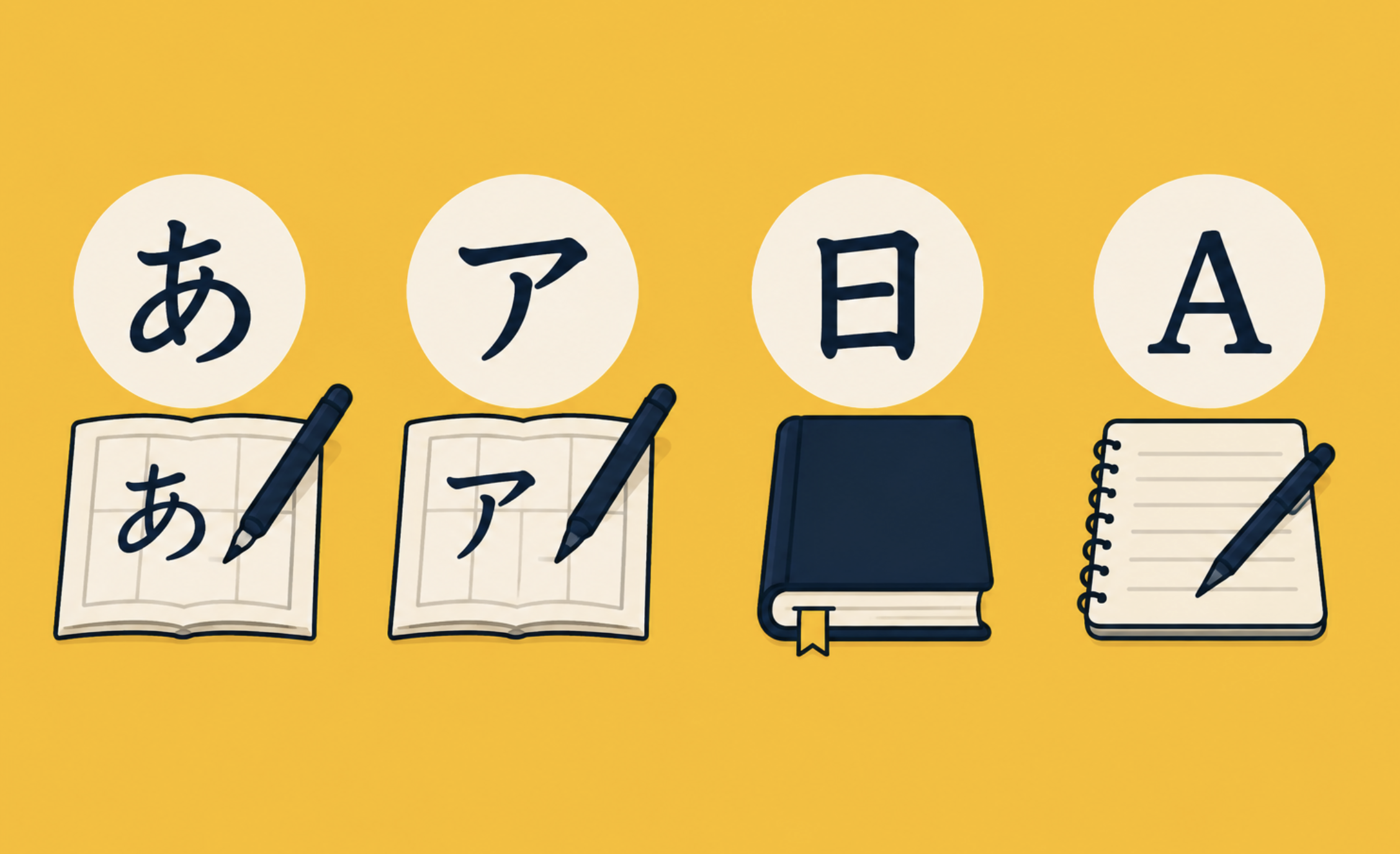
TL;DR: Four primary systems make up the overall modern Japanese writing system,
including hiragana, katakana, kanji, and romaji. Each of these writing systems serves a
unique purpose and supplements the others in conveying meaning in everyday
communication in Japanese. For example, hiragana and katakana are phonetic syllabaries,
kanji consists of logographic characters, and romaji represents Japanese words in the Latin
alphabet.
Why learn the four Japanese writing systems?
Comprehending each of these writing systems is necessary for anyone wanting to master
the Japanese language. Learning Japanese can be a satisfying journey, yet it can also be
daunting because of these unique writing systems. Therefore, understanding the four
primary systems is not simply an academic exercise but an essential step toward true
fluency in the language.
What are the benefits of learning hiragana, katakana, kanji, and romaji?
Learning these systems not only helps learners to communicate but it also gives them a
greater understanding of Japan's culture and history. Each script has a unique purpose and
significance, which contributes to the beauty and elegance of the language.
The main benefit of committing time and effort to learning these writing systems using the
Memrise app is that it will lay a firm foundation for fluency, thus enhancing your overall
language-learning experience. Ultimately, embracing these scripts is not only about learning
a language; it is also about gaining access to a rich cultural tapestry that the Japanese
language offers.
In practice, Japanese writing often combines all four systems. For example, sentences might
include hiragana for grammar, kanji for nouns and verbs, katakana for foreign words, and
romaji in some contexts. This mixture of scripts reflects the language's cultural complexity.
Once mastered, learners can navigate multiple contexts, whether via casual conversations,
academic pursuits, or professional environments.
With that said, here is a deeper exploration of the key attributes of each of the four Japanese
writing styles.
What is hiragana?
Hiragana is a phonetic alphabet (syllabary) that consists of 46 characters, each representing
a native Japanese sound. These characters are rounded and flowing in design, which makes
them visually distinct.
Hiragana is primarily used for native Japanese words, grammatical particles, verb endings,
and spelling out the pronunciation of difficult kanji characters.
By using hiragana, those looking to learn Japanese can create simple sentences without
using kanji. Hiragana is typically the first phase towards mastering the language, as it serves
to create a strong basis upon which other skills can be built.
Hiragana is characterised by its curvy and cursive style, which contributes to its ease of
writing and readability.
What is katakana?
Katakana, often viewed as the counterpart to hiragana, consists of the same 46 sounds but
is written with sharp, angular strokes.
Katakana is primarily used for foreign loanwords (e.g., words borrowed from other
languages), scientific terms, and onomatopoeia (words that phonetically mimic sounds).
The katakana writing systems helps differentiate words of foreign origin from native
Japanese words, which makes it essential for understanding key elements, such as modern
vocabulary and expressions.
Katakana is blocky and straight-edged, which contrasts sharply with the flowing nature of
Hiragana.
What is kanji?
Kanji, an essential part of the Japanese writing system, consists of thousands of logographic
symbols borrowed from Chinese characters. Each kanji symbol represents a core idea or
meaning, rather than just a sound.
Kanji is chiefly used for the root meanings of nouns, as well as adjectives and verbs.
With the complexity of kanji, learners need to start by developing a solid understanding of
hiragana and katakana, as they often help clarify the pronunciation and usage of kanji in
context.
Kanji characters are visually intricate and can range from quite simple to incredibly complex,
which showcases a rich artistic heritage that reflects their Chinese origins.
What is romaji?
Romaji refers to the representation of Japanese words using the Latin (Roman) alphabet,
which draws parallels with how English is written.
Romaji is commonly used for street signs aimed at tourists, passports, technical acronyms,
and typing Japanese on standard keyboards.
While romaji is helpful for beginners, mastering hiragana, katakana, and kanji is essential for
attaining fluency in Japanese.
How do these writing styles work together?
In everyday Japanese sentences, these four writing styles combine seamlessly. For
instance, a sentence might include kanji for the main concepts, hiragana for grammatical
elements, katakana for foreign loanwords, and romaji in contexts requiring Roman
characters.
Japanese writing system overview
This table offers a brief overview of the four Japanese writing styles, including each style's
type, how it is used, and its visual style:
Frequently asked questions
Why should I learn hiragana and katakana first?
Before taking on the complexities of Japanese, many educators emphasise that mastering
hiragana and katakana provides essential skills for reading and writing. Hiragana and
katakana cover 46 sounds each, so between them you can write any Japanese word
phonetically within a few weeks of starting, while kanji runs to thousands of characters and
takes years.
Can I learn Japanese using only romaji?
Romaji is ideal for beginners, and it is how most people type Japanese on a standard
keyboard. However, relying solely on it may hinder a more comprehensive understanding of
the Japanese language. The problem is that almost nothing written for Japanese readers
uses it. Signs, menus, books, subtitles and websites are all in hiragana, katakana and kanji.
A romaji-only learner can speak and listen but may struggle to read the language.
How many kanji characters are there?
While there are thousands of kanji characters, around 2,000 kanji cover most of what you
will encounter in daily life. Understanding roughly 1,000 to 2,000 characters will help with
reading Japanese comfortably. Many of the other kanji characters are rare, historical or
limited to personal and place names.
Is it necessary to learn every kanji?
No, it is not necessary to learn every kanji as many native speakers do not know every kanji
character either. Instead, focus on the most frequently used characters first, as they will
serve you best in everyday conversation and materials.