

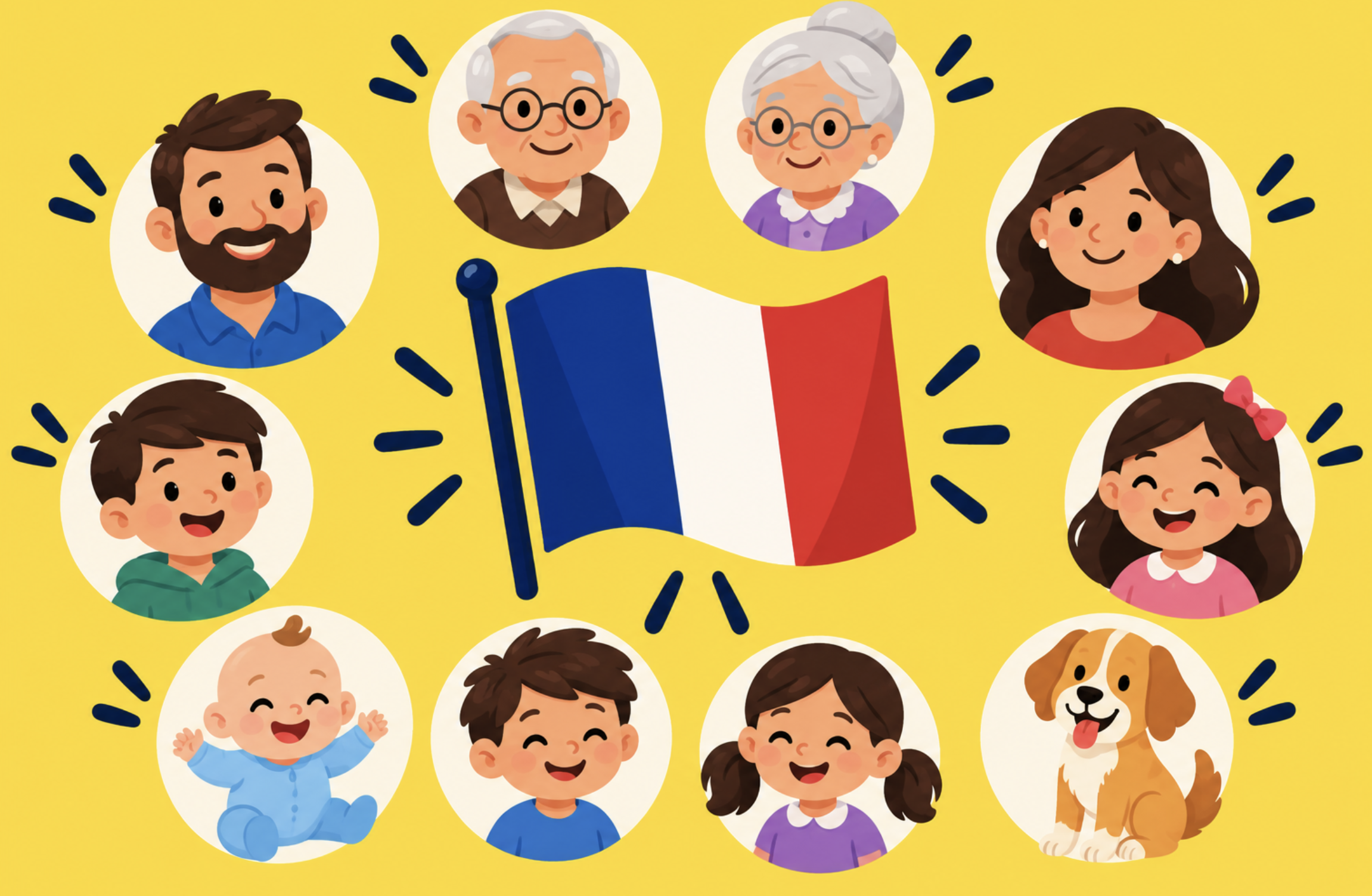
TL;DR: The most common French family words include père (father), mère (mother), frère (brother), sœur (sister), fils (son), fille (daughter), mari (husband), femme (wife), oncle (uncle), and tante (aunt). French, just like English, also distinguishes between singular and plural forms and between masculine and feminine relatives. Learners usually encounter family vocabulary during the first stages of learning French. This is because it helps them introduce themselves and their family members. They can also use French family words to describe relationships or talk about people they know.
This guide covers the fifteen everyday French family words in a table with examples, then takes sister, brother, husband and wife, and uncle and aunt one at a time, showing each with the possessive adjectives you need to use them. It finishes with extended family: cousins, nieces and nephews, and the beau- and belle- prefixes that cover both in-laws and step-relations.
What are the common family members in French?
The basic French family words are straightforward once you’ve learnt the gender of each noun. Here is a complete rundown of the French family vocabulary, with examples:
| English | French | Example |
| Mother | mère |
Ma mère: my mother |
| Father | père |
Mon père: my father |
| Parents | parents |
Mes parents: my parents |
| Sister |
sœur |
Ma sœur: my sister |
|
Brother |
frère |
Mon frère: my brother |
| Son |
fils |
Mon fils: my son |
| Daughter |
fille |
Ma fille: my daughter |
| Husband |
mari |
Mon mari: my husband |
| Wife | femme |
Ma femme: my wife |
| Uncle | oncle |
Mon oncle: my uncle |
|
Aunt |
tante |
Ma tante: my aunt |
|
Grandfather |
grand-père |
Mon grand-père: my grandfather |
|
Grandmother |
grand-mère |
Ma grand-mère: my grandmother |
|
Cousin |
cousin |
Mon cousin: my male cousin |
|
Cousin (female) |
cousine |
Ma cousine: my female cousin |
French nouns have grammatical gender, and language learners should familiarise themselves with the appropriate article or possessive form. For instance, oncle is masculine while tante is feminine.
How do you say sister in French?
The word for sister in French is sœur, and its plural form is sœurs (sisters). When used in a sentence, someone can say “j’ai une sœur” to mean “I have a sister”. Here are examples of the word used with a possessive adjective:
- Ma sœur: my sister
- Ta sœur: your sister
- Sa sœur: his/her sister
- Mes sœurs: my sisters
The œ spelling when writing sister in French represents a sound that does not have an exact match in standard English. In most dictionaries, the pronunciation is represented using the International Phonetic Alphabet as /sœʁ/.
It can help to learn ma sœur as a complete phrase because it helps you connect the noun with the possessive form. Learning apps like Memrise introduce learners to possessive adjectives early to help them use the words effectively in conversation.
How do you say brother in French?
The word for brother in French is frère in singular form and frères in plural form. Because the word is masculine, you use mon for my. Here are a few examples to help you get started:
- Mon frère: my brother
- C’est mon frère: he is my brother
- Mon frère est grand: my brother is tall
When referring to brothers and sisters together, the French vocabulary uses frères et sœurs.
How do you say husband and wife in French?
The word for husband in French is mari, while the word for wife is femme. For instance, “mon mari travaille à Paris” translates to “my husband works in Paris”, while “ma femme français” means “my wife speaks French”.
Learners should understand that the word femme has an important pronunciation point. While the word itself is written with an initial “f”, its pronunciation is approximately /fam/. This follows a different pronunciation pattern than English speakers might expect.
French uses femme and mari for everyday meanings of wife and husband. Both these words can be combined with possessive adjectives. Here are a few examples:
- Ma femme: my wife
- Mon mari: my husband
- Ta femme: your wife
- Ton mari: your husband
How do you say uncle and aunt in French?
The French word for uncle is oncle, while aunt is tante. Their plural forms are oncles and tantes, respectively. Here are two examples:
- Mon oncle habite à Lyon: my uncle lives in Lyon
- Ma tante est médecin: my aunt is a doctor
How do you say uncle and aunt in French?
When it comes to cousins, the French vocabulary distinguishes between masculine and feminine forms: cousin for male and cousine for female. The plural forms are cousins and cousines, respectively.
Other useful French extended-family vocabulary includes the following:
- Neveu: nephew
- Nièce: niece
- Petit-fils: grandson
- Petit-fille: granddaughter
- Beau-frère: brother-in-law
- Belle-sœur: sister-in-law
- Demi-frère: half-brother/stepbrother
- Demi-sœur: half-sister/stepsister
In French, the prefixes beau- (masculine) and belle- (feminine) cover both step-relations and in-laws. Learners should pay close attention to these prefixes because they appear in several French relationship terms.
Frequently asked questions
How do you say husband in French?
The word brother in French is frère in singular and frères in plural. You can say mon frère for my brother and j’ai un frère for I have a brother. The feminine equivalent is sœur, so you can learn to say brothers and sisters, expressed as frères et sœurs.
What is "family" in French?
Family is la famille in French, and the plural is les familles. It is a feminine noun, so my family is ma famille. Use famille for relatives collectively, as in toute la famille for the whole family, and the individual terms such as oncle, tante and cousine when you need to name a specific relationship.
How do you say "parents" in French?
Parents is parents in French, with the singular forms being père for father and mère for mother. For instance, mes parents translates to my parents. While the word looks identical to the English word for the same meaning, the pronunciation is quite different.
How do you say "sister" in French?
Sister is sœur in French, and sisters is sœurs. The œ is a single letter rather than an o and an e side by side, and it stands for a vowel with no exact English equivalent; dictionaries write the pronunciation as /sœʁ/. With a possessive it becomes ma sœur, my sister, and “I have a sister” is j’ai une sœur.