

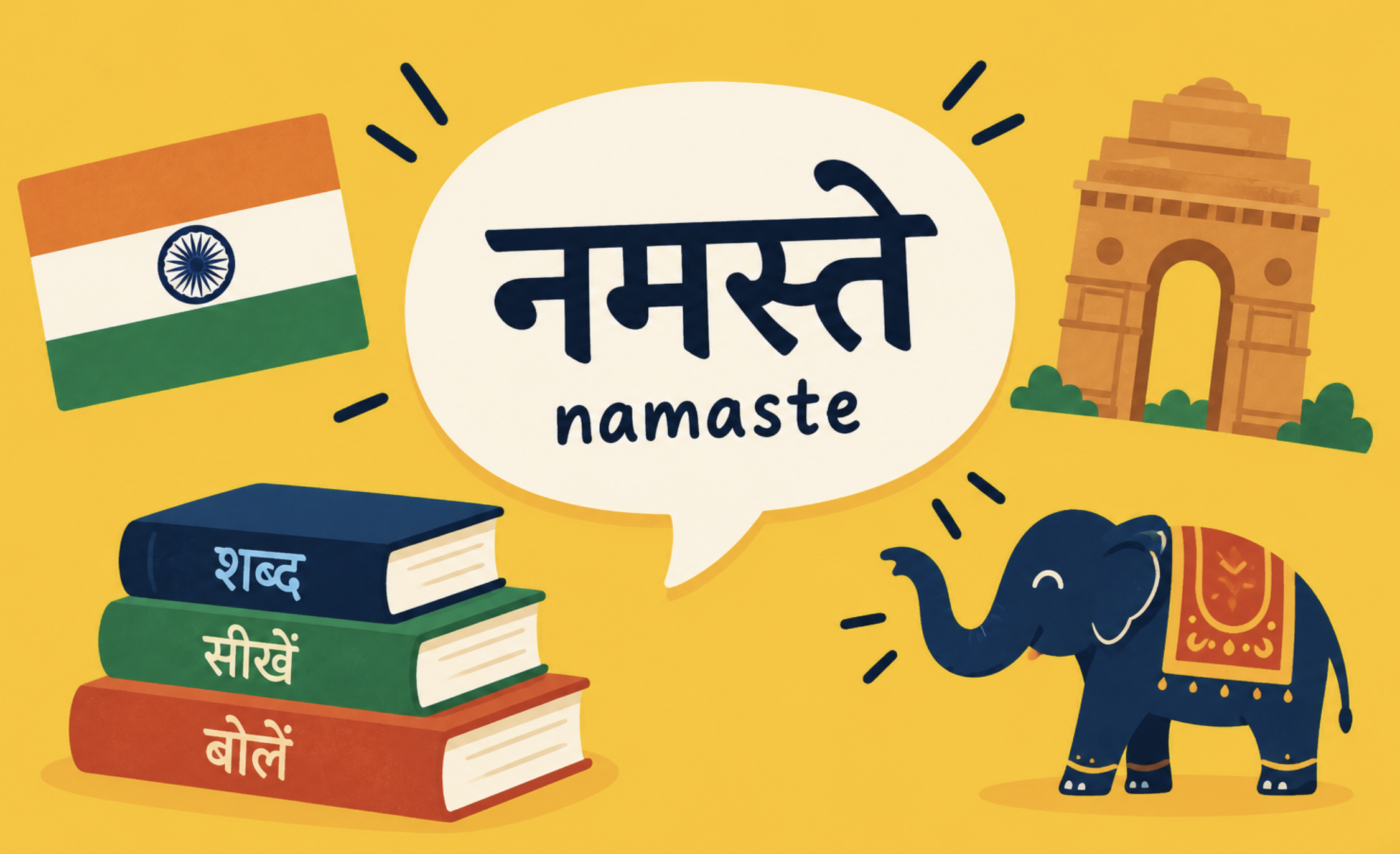
TL;DR: The 100 entries below cover greetings (नमस्ते, namaste), polite responses (धन्यवाद,
dhanyavaad, thank you), pronouns, question words, the most common verbs, numbers and time, food
and shopping, directions, and the repair phrases you need when a conversation stalls. Use आप (aap)
for “you” with strangers and elders. Learn each entry in Devanagari alongside its romanisation, and
learn whole phrases rather than single words, because Hindi marks gender and formality in ways
English does not.
Hindi vocabulary cannot always be translated directly into English. A word may change according to
gender. The appropriate form of a phrase can depend on who is speaking and who is being
addressed. The 100 entries below are grouped according to what they allow a beginner to say and
understand.
What should you know before using these Hindi words?
Hindi is written in Devanagari. This is a script that runs from left to right. Its characters represent
sounds more consistently than English spelling. Devanagari still needs to be learned alongside audio or video to fully understand it. Romanisation provides a useful starting point, although different sources may spell the same Hindi sound in different ways.
Memrise provides thousands of authentic videos to learn Hindi. These videos feature the exact words you’ve just learned and how to use them accurately. Memrise also provides you with unlimited human-like conversation practice to put your knowledge into action.
Basic Hindi sentences commonly follow a subject–object–verb order. “I drink water” is structured more like “I water drink”. Hindi also regularly places postpositions after nouns where English generally puts prepositions before them.
Nouns can be masculine or feminine. This is something you may be familiar with, as gender is
common in many other languages. It can affect adjectives and verb forms. This includes phrases
describing the speaker. Some of the tables below therefore show two possible forms. The correct
choice may depend on the gender of the speaker or the noun being described.
Learning complete expressions helps these patterns become familiar without requiring beginners to master the entire grammar system first.
How does politeness work in Hindi?
Some languages have more polite forms that should be used in certain situations. Hindi is one of
these languages.
Hindi has several forms of “you”. आप (aap) is respectful and appropriate for elders and formal
situations. It should also be used when meeting strangers. तुम (tum) is familiar and commonly used with friends or people of a similar age. तू (tu) expresses greater intimacy. Be aware that these words can sound disrespectful when used with the wrong person.
Beginners should use आप when uncertain. It is safer to begin respectfully and adopt a more familiar form later.
The word जी (ji) also expresses respect. It may follow someone’s name or title and can be added to
short responses. These choices affect the accompanying verb. Politeness in Hindi involves grammar as well as vocabulary, and is important for all learners to understand.
Which Hindi greetings and introductions should you learn?
Hindi greetings often reflect the relationship between the speakers. The respectful आप forms in this table provide a safe starting point. Both forms are shown if a phrase changes according to the gender of the person being addressed.
| Hindi | Romanisation | English and usage |
| 1. नमस्ते | Namaste | Hello; also used when parting |
| 2. सुप्रभात | Suprabhaat | Good morning; relatively formal |
| 3. फिर मिलेंगे | Phir milenge | See you again |
| 4. आप कैसे हैं? / आप कैसी हैं? |
Aap kaise hain?/Aap kaisi hain? |
How are you? Addressing a man/woman |
| 5. मैं ठीक हूँ | Main theek hoon | I am fine |
| 6. आपका नाम क्या है? | Aapka naam kya hai? | What is your name? |
| 7. मेरा नाम … है | Mera naam … hai | My name is… |
| 8. आपसे मिलकर खुशी हुई | Aapse milkar khushi hui | Nice to meet you |
| 9. आप कहाँ से हैं? | Aap kahaan se hain? | Where are you from? |
| 10. मैं … से हूँ | Main … se hoon | I am from… |
| 11. स्वागत है | Swaagat hai | Welcome |
| 12. नया क्या है? | Naya kya hai? | What’s new? |
Which polite Hindi words and basic responses are essential?
A few short responses can make an immediate difference to a Hindi conversation and allow learners to respond properly to questions. जी (ji) is especially useful because it adds respect to names and brief answers. हाँ जी (haan ji) is a more respectful form of “yes”.
The words translated as “please” and “thank you” do not always appear in the same situations as their English equivalents. कृपया (kripaya) can sound formal and is often seen in instructions or public notices. Requests are also made polite through respectful verb forms and tone of voice.
| Hindi | Romanisation | English and usage |
| 13. हाँ | Haan | Yes |
| 14. नहीं | Nahin | No; also means “not” |
| 15. कृपया | Kripaya | Please; relatively formal |
| 16. धन्यवाद | Dhanyavaad | Thank you |
| 17. माफ़ कीजिए | Maaf kijiye | Sorry or excuse me; respectful |
| 18. कोई बात नहीं | Koi baat nahin | No problem; literally “no matter" |
| 19. ठीक है | Theek hai | Okay; that is fine |
| 20. जी | Ji | Respectful response or suffix |
Which Hindi pronouns and words for people matter most?
Hindi pronouns do not correspond exactly with English ones. वह (vah, commonly pronounced voh)
can mean “he”, “she”, or “that”. The surrounding sentence provides the missing information. यह (yah, commonly pronounced yeh) can also mean “this”, “he”, or “she”.
The choice between आप and तुम also changes the verb used with it. To avoid the possibility of
offending somebody, learners should continue using आप unless a more familiar relationship has been established.
| Hindi | Romanisation | English and usage |
| 21. मैं | Main | I |
| 22. हम | Hum | We |
| 23. आप | Aap | You; respectful or plural |
| 24. तुम | Tum | You; familiar |
| 25. वह | Vah/voh | He, she, or that |
| 26. यह | Yah/yeh | This, he, or she |
| 27. वे | Ve | They or those |
| 28. व्यक्ति | Vyakti | Person; relatively formal |
| 29. दोस्त | Dost | Friend |
| 30. परिवार | Parivaar | Family |
Which Hindi question words should beginners know?
Question words allow a small vocabulary to do much more work (and keep others engaged in
conversation). They are important and need to be in the first 100 words you learn.
Keep in mind that क्या (kya) means “what”, but it can also appear at the beginning of a sentence to turn a statement into a yes-or-no question.
Some question forms change to agree with the noun or person being discussed. कितना and कितनी
can both mean “how much” or “how many”. Learning these forms in complete questions makes their differences easier to understand and get used to.
| Hindi | Romanisation | English and usage |
| 31. क्या | Kya | What; also introduces yes-or-no questions |
| 32. कौन | Kaun | Who |
| 33. कहाँ | Kahaan | Where |
| 34. कब | Kab | When |
| 35. क्यों | Kyon | Why |
| 36. कैसे? / कैसी? | Kaise?/kaisi? | How? Form changes with gender |
| 37. कितना? / कितनी? | Kitna?/kitni? | How much or how many? |
| 38. कौन-सा? / कौन-सी? | Kaun-sa?/kaun-si? | Which one? |
Which Hindi verbs are most useful?
Hindi verbs are usually listed in the infinitive, which commonly ends in -ना (-na). This is the dictionary form rather than the form that will necessarily appear in a sentence. Verb endings can change according to tense, gender, number, and politeness.
चाहिए (chahiye) is an exception within this list because it is not an infinitive. It is used in an extremely useful pattern: मुझे पानी चाहिए (mujhe paani chahiye), meaning “I need water” or “I want water”.
Learn each verb with a complete example instead of memorising the English translation alone. This follows the word order and the forms that Hindi speakers actually use.
| Hindi | Romanisation | English and usage |
| 39. होना | Hona | To be or to happen |
| 40. करना | Karna | To do |
| 41. जाना | Jaana | To go |
| 42. आना | Aana | To come |
| 43. चाहना | Chahna | To want |
| 44. चाहिए | Chahiye | To need or want something |
| 45. जानना | Jaanna | To know |
| 46. समझना | Samajhna | To understand |
| 47. बोलना | Bolna | To speak |
| 48. सुनना | Sunna | To listen or hear |
| 49. देखना | Dekhna | To see, look or watch |
| 50. खाना | Khaana | To eat |
| 51. पीना | Peena | To drink |
| 52. देना | Dena | To give |
Which Hindi describing and linking words are useful?
Adjectives aren’t there for decoration. They make basic statements more precise, while linking words allow learners to connect ideas. Some Hindi adjectives change according to the gender and number of the noun. अच्छा (achchha) may become अच्छी (achchhi) with a feminine noun.
The table gives the usual masculine singular form of adjectives where forms can change. Words
including गरम (garam) and ज़्यादा (zyaada) generally remain unchanged.
और (aur) and लेकिन (lekin) are particularly valuable because they turn separate statements into
connected thoughts. A beginner can use them to explain that something is good but expensive, or that they want food and water.
| Hindi | Romanisation | English and usage |
| 53. अच्छा | Achchha | Good; masculine singular form |
| 54. बुरा | Bura | Bad; masculine singular form |
| 55. बड़ा | Bada | Big; masculine singular form |
| 56. छोटा | Chhota | Small; masculine singular form |
| 57. गरम | Garam | Hot |
| 58. ठंडा | Thanda | Cold; masculine singular form |
| 59. ज़्यादा | Zyaada | More, too much, or very |
| 60. थोड़ा | Thoda | A little; masculine singular form |
| 61. और | Aur | And; also means “more” in some contexts |
| 62. लेकिन | Lekin | But |
Which Hindi numbers and time words should you learn?
The first numbers are useful for things like ordering items and buying tickets. Hindi numbers become less predictable as they increase. The remaining forms need to be learned individually rather than created by applying one simple pattern. Hindi numbers are important for all learners.
The word कल (kal) has two possible time references: it can mean either “yesterday” or “tomorrow”.
The surrounding sentence and its verb establish whether the speaker is looking backwards or
forwards.
Hindi also distinguishes between आज (aaj) meaning today and अभी (abhi) meaning now or at this
moment. These short words can make a simple sentence more detailed (and useful!).
| Hindi | Romanisation | English and usage |
| 63. एक | Ek | One |
| 64. दो | Do | Two |
| 65. तीन | Teen | Three |
| 66. आज | Aaj | Today |
| 67. कल | Kal | Yesterday or tomorrow |
| 68. अभी | Abhi | Now or just now |
| 69. बाद में | Baad mein | Later |
| 70. समय | Samay | Time |
| 71. दिन | Din | Day |
| 72. रात | Raat | Night |
Which Hindi words help with food and shopping?
Food and shopping phrases demonstrate why complete expressions are more useful than isolated vocabulary. Hindi commonly expresses hunger as something that has occurred to the speaker: मुझे भूख लगी है translates literally along the lines of “hunger has happened/is happening to me”.
| Hindi | Romanisation | English and usage |
| 73. पानी | Paani | Water |
| 74. भोजन | Bhojan | Food or a meal; relatively formal |
| 75. चाय | Chaay | Tea |
| 76. मुझे भूख लगी है | Mujhe bhookh lagi hai | I am hungry |
| 77. मुझे प्यास लगी है | Mujhe pyaas lagi hai | I am thirsty |
| 78. यह कितने का है? | Yeh kitne ka hai? | How much is this? Common masculine form |
| 79. मुझे यह चाहिए | Mujhe yeh chahiye | I want or need this |
| 80. यह बहुत महँगा है / महँगी है |
Yeh bahut mahanga hai/mahangi hai |
This is very expensive; masculine/feminine |
| 81. कम मसालेदार | Kam masaaledaar | Less spicy |
| 82. बिल दीजिए | Bill dijiye | The bill, please; respectful |
Which Hindi phrases help with travel and directions?
Travel phrases are useful when they can be adapted to a destination. Adding a place before कहाँ है? (kahaan hai?) creates a basic question, such as “Where is the station?”
The words for left and right often appear as बाएँ (baayen) and दाएँ (daayen) when giving directions.
Respectful instructions ending in -इए or -ईए, such as रोकिए (rokiye), are safer when speaking to
drivers or strangers.
Everyday Hindi also contains familiar English loanwords. स्टेशन and टिकट are written in Devanagari
but remain recognisable to English speakers. Learning to say “ticket” is about as easy as Hindi gets.
| Hindi | Romanisation | English and usage |
| 83. कहाँ है? | Kahaan hai? | Where is…? Add the place before the phrase |
| 84. बाएँ | Baayen | To the left |
| 85. दाएँ | Daayen | To the right |
| 86. सीधे | Seedhe | Straight ahead |
| 87. पास | Paas | Near |
| 88. दूर | Door | Far |
| 89. स्टेशन | Station | Station |
| 90. टिकट | Tikat | Ticket |
| 91. यहाँ रोकिए, कृपया | Yahaan rokiye, kripaya | Stop here, please |
Which Hindi phrases help when something goes wrong?
Language-repair phrases help beginners continue a conversation when they miss a word or cannot respond. Asking someone to speak slowly or repeat a sentence is often more useful than pretending to understand.
Some phrases change with gender. In मैं नहीं समझता हूँ / समझती हूँ, the first version is normally used by
a male speaker and the second by a female speaker. Phrases addressing another person may
change according to that person’s gender.
| Hindi | Romanisation | English and usage |
| 92. मदद! | Madad! | Help! |
| 93. क्या आप मेरी मदद कर सकते हैं? / सकती हैं? |
Kya aap meri madad kar sakte hain?/sakti hain? |
Can you help me? Addressing a man/woman |
| 94. मैं नहीं समझता हूँ / समझती हूँ |
Main nahin samajhta hoon/samajhti hoon |
I do not understand; male/female speaker |
| 95. मुझे हिंदी नहीं आती | Mujhe Hindi nahin aati | I do not speak or know Hindi |
| 96. क्या आप अंग्रेज़ीबोलते हैं? / बोलती हैं? |
Kya aap angrezi bolte hain?/bolti hain? |
Do you speak English? Addressing a man/woman |
| 97. धीरे बोलिए | Dheere boliye | Please speak slowly |
| 98. फिर से कहिए | Phir se kahiye | Please say it again |
| 99. इसका क्या मतलब है? | Iska kya matlab hai? | What does this mean? |
| 100. मुझे डॉक्टर चाहिए | Mujhe doctor chahiye | I need a doctor |
Memrise can help connect written Hindi with native-speaker pronunciation, and support repeated
vocabulary review. Speaking practice is also important. It reveals things like vowel length and
sentence stress that may be difficult to notice alone.
Frequently asked questions
Is Hindi difficult to learn?
It depends on your starting point. Hindi has sounds that English does not use and verb forms that
change with gender, number, and formality. Devanagari, though, is more systematic than English
spelling, so reading becomes reliable quickly once the script is learned. Most English speakers find
the script easier than expected and the verb agreement harder.
Does Hindi have masculine and feminine words?
Yes. Every Hindi noun is either masculine or feminine, and the gender affects the words around it:
adjectives, verb endings and sometimes the form of a phrase describing the speaker. अच्छा (achchha,
good) becomes अच्छी (achchhi) before a feminine noun. This is why several entries in the tables
above show two forms rather than one.
What is the difference between aap, tum, and tu?
They are three levels of “you”. आप (aap) is respectful and is the right choice for elders, strangers and formal situations. तुम (tum) is familiar, used with friends and people of a similar age. तू (tu) is the most intimate and can sound rude if misjudged. Each takes a different verb form, so the choice changes the sentence around it. Beginners should default to आप (aap).
Should beginners learn Devanagari?
Yes. Romanisation is a reasonable way to start, but it is inconsistent, so you should be aware that
different sources spell the same Hindi sound differently and the same word can look like two words. Devanagari pairs sounds with characters far more reliably than English spelling does, and it removes that ambiguity.
Is Hindi written as it is pronounced?
Mostly, but not perfectly. Devanagari is far more consistent than English spelling: a character
generally represents the same sound wherever it appears. There are exceptions, the most common being the inherent vowel “a”, which is often not pronounced at the end of a word. Listening to audio is a great way to copy and learn vowel length, stress and the natural rhythm of a sentence.
Are Hindi and Urdu the same language?
Not quite, though the everyday spoken forms are largely mutually intelligible. Hindi and Urdu share a common grammatical base and most core vocabulary, so a conversation about ordinary things works in both languages. However, they each follow different scripts, Devanagari for Hindi and a Perso-Arabic script for Urdu. Moreover, they each draw formal and literary vocabulary from different sources, Sanskrit for Hindi and Persian and Arabic for Urdu.