

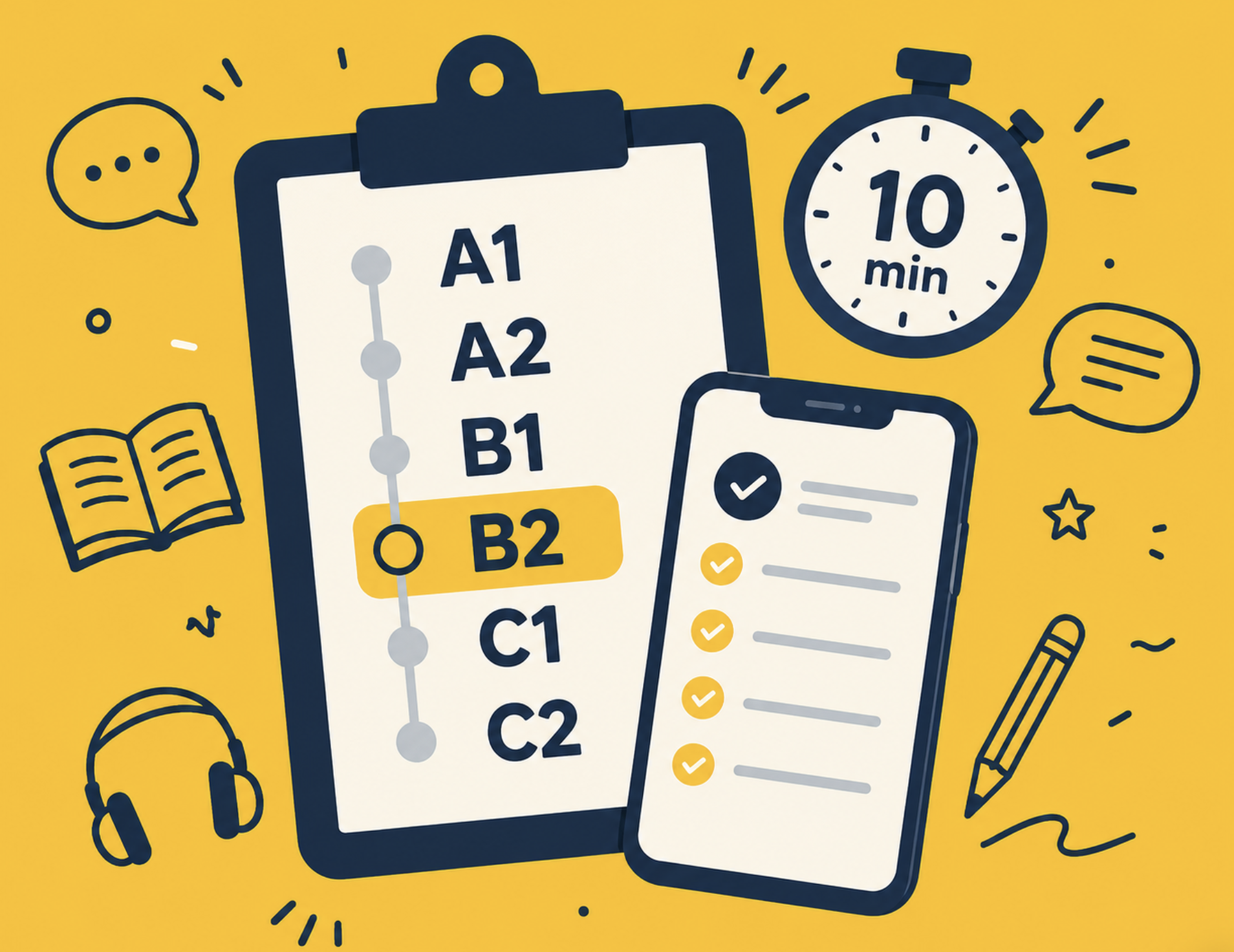
What an English level test actually measures
An English level test answers one practical question: how much English can you use right now? It
is not based on your grammar score from school, or how many words you once memorised, but
what you can do with the language today, in real situations.
Most serious tests measure this against the Common European Framework of Reference for
Languages (CEFR). The CEFR describes ability in "can-do" terms across four skills:
- Listening, understanding speech, from slow and clear to fast and idiomatic.
- Reading, making sense of text, from signs and short notes to dense articles.
- Speaking, holding a conversation, from basic introductions to fluent debate.
- Writing, producing text, from filling in a form to writing a structured report.
A good level test looks at these skills separately, because most learners are better at some than
others. You might read at B2 but speak at B1. Knowing the gap is the point.
The CEFR scale: A1 to C2
The CEFR has six levels in three bands. Here is what each one looks like in practice.
| Level | Band | What you can do |
| A1 | Beginner | Introduce yourself, ask and answer simple questions, understand slow, clear speech on familiar topics. |
| A2 | Elementary | Handle short everyday exchanges, shopping, directions, routines, and write simple notes. |
| B1 | Intermediate | Cope with most situations while travelling, describe experiences, and explain opinions briefly. |
| B2 | Upper Intermediate | Hold fluent conversations with native speakers, follow most TV and films, and write clear, detailed text. |
| C1 | Advanced | Use English flexibly for academic and professional purposes and understand demanding, longer texts. |
| C2 | Proficient | Understand virtually everything you hear or read and express yourself precisely in complex situations. |
There are two things worth knowing. First, B2 is the level most universities and employers ask
for, so it is the one most learners aim to reach. Second, the jump from A2 to B1 is where you
stop translating in your head and start thinking in English. It is the level most people feel they
"plateau" at, which is usually a sign to change how you practise rather than how hard you try. In
most cases, that change is adding real speaking practice, which is why we pair our level-matched
content with MemBot, our AI conversation partner with 190 scenarios. Through 74 goal-based
Missions, the bot checks whether you achieved what you set out to say, and 115 free-flowing
Chats are available for relaxed practice.
What to expect, and how long it takes
There are two honest ways to find your level, and they answer slightly different questions.
A guided self-assessment asks you to read clear descriptions of what you can do at each level
and pick the one that fits, skill by skill. It takes about 10 minutes, costs nothing, and is the fastest
way to orient yourself before you start learning. We use this method for our test because it is
built directly on the official CEFR descriptors, which are the same statements Cambridge and the
Council of Europe use.
An adaptive question test gives you reading and listening questions that get harder or easier
based on your answers. It takes 15-50 minutes depending on the test and is best for when you
need a number rather than a sense of direction.
Both are useful. If you are choosing where to start a course, the 10-minute self-assessment is
enough. If you are deciding whether you are ready to sit IELTS, you should take a longer
adaptive test or a full practice exam.
One caveat that applies to every free online test, including ours: the result is a guide, not a
certificate. Official proof of level only comes from a sat-and-marked exam such as IELTS, TOEFL
or a Cambridge qualification.
How your level maps to IELTS, TOEFL and Cambridge
This is where learners get confused, so here is the mapping in one place. These are approximate
alignments, not exact equivalences as each exam tests slightly different things. The official
bodies publish these as guidelines rather than guarantees.
| CEFR | IELTS (band) | TOEFL iBT (total) | Cambridge English Scale | Cambridge exam |
| A1 | n/a | n/a | 100-119 | |
| A2 | n/a | n/a | 120-139 | A2 Key (KET) |
| B1 | 4.0-5.0 | 42-71 | 140-159 | B1 Preliminary (PET) |
| B2 | 5.5-6.5 | 72-94 | 160-179 | B2 First (FCE) |
| C1 | 7.0-8.0 | 95-120 | 180-199 | C1 Advanced (CAE) |
| C2 | 8.5-9.0 | n/a | 200-230 | C2 Proficiency (CPE) |
You can also practice for IELTS exams on memrise.com, by creating an account and navigating to 'switch product' in the profile menu.
A few notes so you read this correctly:
● IELTS and TOEFL don't really report A1 and A2. Their scoring starts to be meaningful around
B1, which is why those cells are marked n/a.
● The Cambridge English Scale has CEFR built in, the score band tells you the level directly.
● TOEFL iBT changed in January 2026 and now also reports a 1-6 score aligned to CEFR. The
totals above reflect the long-standing 0-120 score most learners still recognise.
● A single test never maps perfectly to another. Use this information to set expectations, not
to predict an exam result to the half-band.
How to take the Memrise English level test
Our test is a free guided self-assessment that takes about 10 minutes. Here is how it works:
1. You read short, plain-English descriptions of what someone can do at each CEFR level.
2. For each of the four skills, listening, reading, speaking and writing, you choose the
description that best matches you today.
3. You will receive your level for each of those skills, plus a clear picture of what to learn next
to move up. Our app then serves you content matched to that level. We maintain 234
English wordlists, which is more than for any other of the 45 languages we curate lists for,
tiered from ‘1000 Most Popular Words’ through level-specific General Vocabulary, and we
track your CEFR level as you progress. Behind that content, there are more than 611,000
audio recordings and 72,000+ native speaker videos, so listening practice at your exact level
is never in short supply.
It is deliberately not a surprise quiz. The aim is to provide an honest snapshot you can act on,
not a score to feel anxious about. Most people find their reading and listening are a level above
their speaking and writing, which is exactly the kind of gap a sensible study plan should target.
Check your level now →
Frequently asked questions
What is English level A1, A2, B1, B2, C1, C2?
They are the six CEFR levels, from A1 (beginner) to C2 (proficient). Level A covers basic users, B
covers independent users, and C covers proficient users. B2 is the level most universities and
employers ask for.
How do I test my English language level?
The quickest way is a free online level test. A guided self-assessment like ours takes about 10
minutes and rates you across listening, reading, speaking and writing. For an official, certified
result, you need to sit a marked exam such as IELTS, TOEFL or a Cambridge English qualification.
Is my English level B2 or C1?
A rough rule is that if you can follow most films and conversations comfortably and write clearly
but still hesitate with complex or academic language, you are likely B2. If you can use English
flexibly for work or study and handle long, demanding texts without much effort, you are closer
to C1. A skill-by-skill test will give you a more reliable answer than self-judgement alone.
How long does an English level test take?
A guided self-assessment takes around 10 minutes, while an adaptive question test takes 15-50
minutes. A full official exam takes two to four hours.
Is the test free?
Yes, our level test is completely free. Official certified exams (IELTS, TOEFL, Cambridge) charge
a fee, because they provide a recognised qualification.