

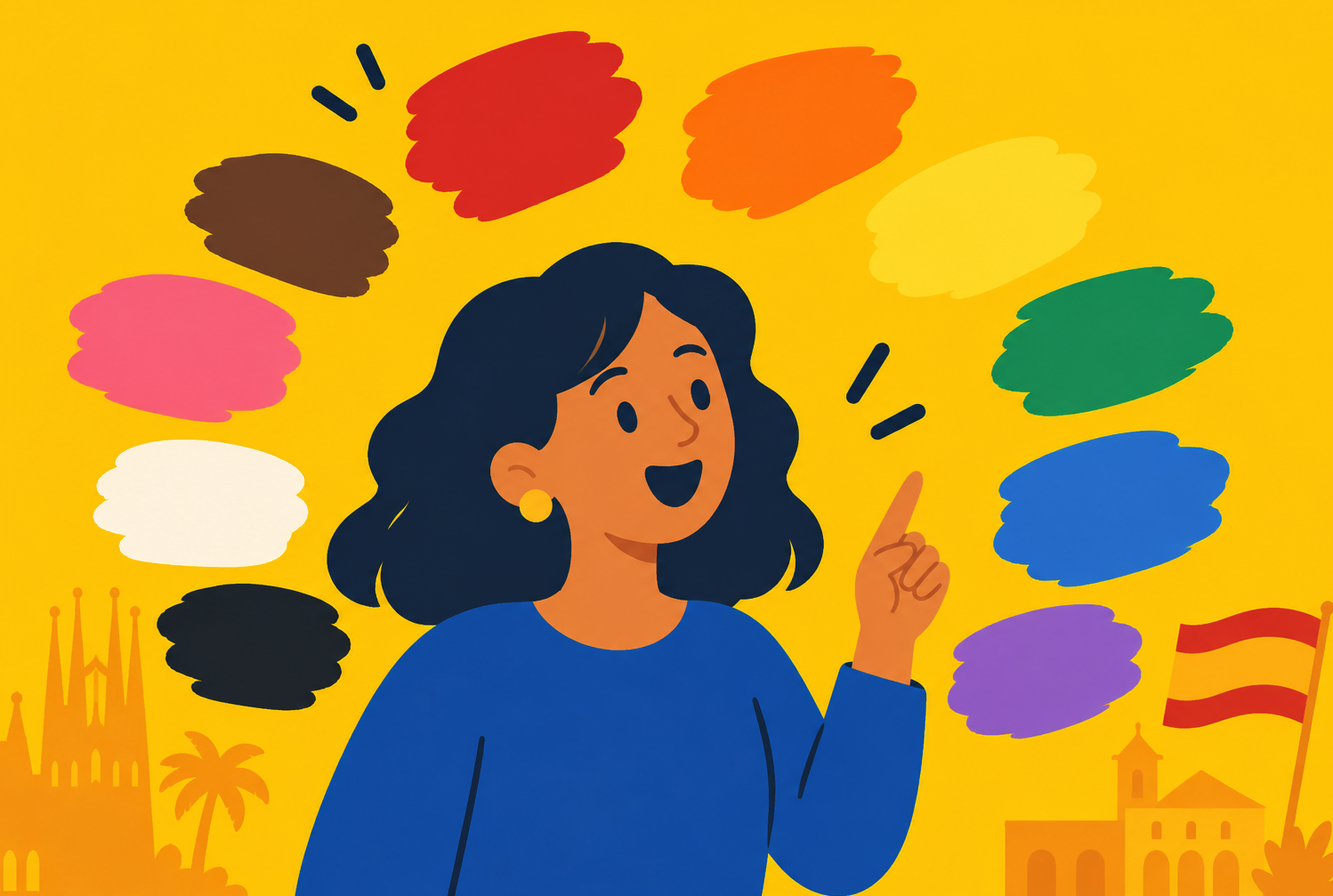
amarillo (yellow), negro (black), and blanco (white). Spanish colour adjectives normally
follow the noun they describe. Some even change to agree with its gender and number.
Vocabulary can also vary slightly between Spanish-speaking regions, which means it is
sometimes important to understand multiple words for the same colours.
This guide covers the most useful Spanish colour names. It also explores their pronunciation
and the grammar needed to use them. The pronunciation guides are approximations for
English speakers. They should be used alongside recordings of native Spanish.
What are the main colours in Spanish?
The main Spanish colours range from everyday forms such as rojo and azul to regional alternatives like marrón and café. The table below gives the masculine singular or standard dictionary form.
| English | Spanish | Beginner pronunciation | Usage note |
| Red | Rojo | ROH-ho | Changes to roja with feminine nouns |
| Orange | Naranja | nah-RAHN-ha | Usually unchanged for gender |
| Yellow | Amarillo | ah-mah-REE-yoh | Changes to amarilla |
| Green | Verde | BEHR-deh | Unchanged for gender |
| Blue | Azul | ah-SOOL | Unchanged for gender |
| Purple | Morado | moh-RAH-doh | Violeta and púrpura are alternatives |
| Pink | Rosa | ROH-sah | Usually unchanged for gender |
| Brown | Marrón | mah-RRON | Café is common in parts of Latin America |
| Black | Negro | NEH-groh | Changes to negra |
| White | Blanco | BLAHN-koh | Changes to blanca |
| Grey | Gris | grees | Unchanged for gender |
| Gold | Dorado | doh-RAH-doh | Changes to dorada |
| Silver | Plateado | plah-teh-AH-doh | Changes to plateada |
| Turquoise | Turquesa | toor-KEH-sah | Usually unchanged for gender |
| Beige | Beige | BEH-heh | Pronunciation and form vary regionally |
Some of the translations are simpler than others. The direct translation of red in Spanish is
rojo, while white in Spanish is blanco. Yellow in Spanish is amarillo. These are
straightforward words to use. Some are more complex. There are several ways to express
purple in Spanish, with morado, violeta, and púrpura all appearing across the Spanish-
speaking world.
Do Spanish colours change for masculine and feminine nouns?
Some Spanish colour adjectives change for gender. Many do use the same form with
masculine and feminine nouns. Words ending in -o, such as rojo, commonly change to -a
with a feminine noun. Colours ending in -e or a consonant generally retain the same gender
form. This can help with learning (though the exceptions to the rule can complicate things).
Colour adjectives must also agree with number. A word ending in a vowel usually takes -s in
the plural and one ending in a consonant usually takes -es.
So, falda verde becomes faldas verdes (green skirt vs green skirts).
Where do colours go in a Spanish sentence?
Spanish colour adjectives normally come after the noun. A yellow bicycle is therefore una
bicicleta amarilla. A grey jacket is una chaqueta gris.
Use ser when simply identifying or describing an object’s colour.
| Spanish | English |
| El libro es azul | The book is blue |
| La ventana es blanca | The window is white |
| Mis calcetines son verdes | My socks are green |
The construction ‘de color’ is also possible when naming a colour rather than using it directly as an adjective: un paraguas de color morado means a purple-coloured umbrella.
How do you say light, dark, and bright colours in Spanish?
Add a modifier to the sentence after the principal colour to describe a specific shade.
Common combinations include:
| Spanish | English |
| Azul claro | Light blue |
| Verde oscuro | Dark green |
| Rosa fuerte | Vivid or bright pink |
| Rojo pálido | Pale red |
The modifier generally comes after the colour, just as the colour follows the noun: una camisa azul claro means a light-blue shirt. Compound colour expressions can follow more
detailed agreement rules. Beginners should learn common combinations as complete
phrases rather than relying on one specific rule.
Users can practise their use of colours with unlimited human-like conversations via Memrise,
ensuring they learn the correct words for the correct situations.
Which Spanish colour words vary by region?
Brown, orange, pink, and purple have especially noticeable regional alternatives. Marrón is
widely used for brown in Spain, while café is common in several Latin American countries.
Castaño often describes brown hair or eyes.
Orange may be naranja or anaranjado, while pink may appear as rosa or rosado. Purple can
be morado, violeta, or púrpura. These alternatives are not simply right or wrong. The most
natural choice depends on the country and sometimes the specific shade being described.
How can you learn Spanish colours more effectively?
Learn each colour through an object and a complete noun phrase. Pairing rojo with un coche
rojo teaches both meaning and word order. Other pairs such as sombrero blanco and
camisa blanca make gender agreement easier to learn and differentiate.
Practise by describing clothing or everyday objects. Memrise can reinforce this process by
pairing useful vocabulary with native-speaker video. This can help learners connect written
colour words with real pronunciation rather than relying only on English approximations.
Frequently asked questions
What is the Spanish word for colour?
The Spanish word for colour is color, pronounced approximately koh-LOR with the stress on
the second syllable. The plural is colores. Note the single o: Spanish does not use the British
spelling colour. It takes no written accent, and the phrase el color rojo means the colour red.
Do all Spanish colours have masculine and feminine forms?
No, not all of them change. Colours ending in -o, such as rojo, blanco and negro, become
roja, blanca and negra before a feminine noun. Colours ending in -e or in a consonant, such
as verde, gris and azul, keep the same form for both genders. All of them still change for
number, so verde becomes verdes in the plural.
What is the difference between marrón and café?
Both mean brown, and the difference is regional rather than one of meaning. Marrón is the
usual word in Spain while café is widely used across much of Latin America. Castaño is the
word for brown hair or eyes in either region. Context matters with café, because it also
means coffee. So remember, un café is a coffee, not a brown!
How can beginners memorise Spanish colours?
Beginners can memorise Spanish colours by connecting each word to an object, image, and
spoken example. Learn complete phrases that demonstrate gender, such as coche rojo and
camisa roja, so the gender of the noun is reinforced by the colour. Then retrieve the Spanish
phrase from memory before checking it.