

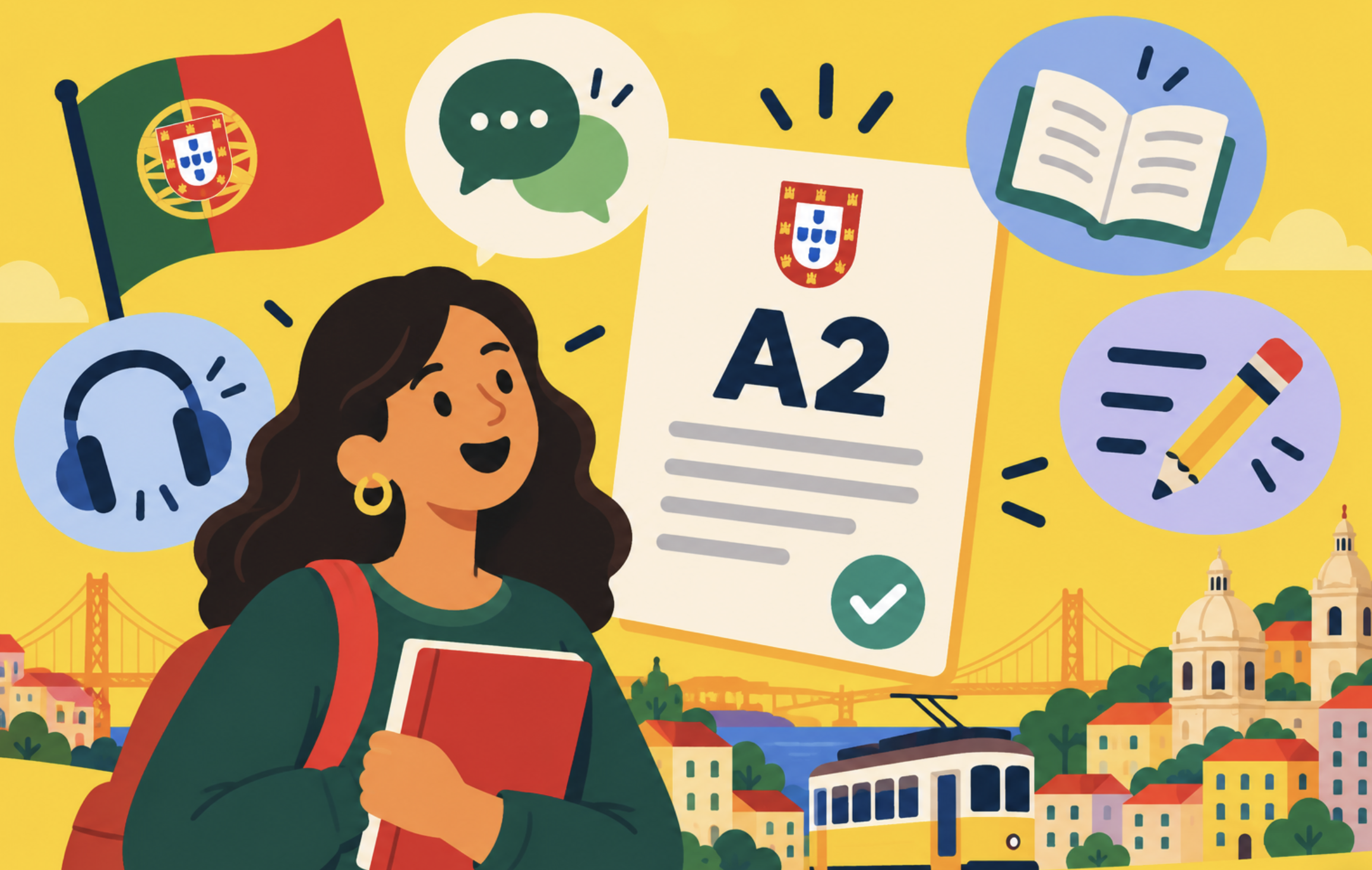
TL;DR: CIPLE, Certificado Inicial de Português Língua Estrangeira, is the official Portuguese-language learning exam at A2 level on the CEFR scale. It assesses basic Portuguese communication through reading, writing, listening, and speaking tasks. The exam is designed for people preparing for Portuguese citizenship or other situations where A2 Portuguese is required, and CAPLE administers it. Passing the exam provides formal evidence of basic language ability.
This guide explains what CIPLE is, who administers it and what A2 actually requires you to be able to do. It then covers the four skills the exam assesses, how to prepare for the listening and speaking sections in European Portuguese specifically, and how to structure your study in the weeks before the exam.
While the CIPLE is often described as the A2 Portuguese exam, this description leaves out an important distinction. A2 is a language level, and CIPLE is the examination that certifies that level.
Learners should understand the difference, especially if they need documented evidence of their language ability. Understanding what the exam measures, who administers it, and what A2 actually represents can help you prepare more efficiently.
What is the CIPLE exam?
CIPLE is an official examination designed to assess basic Portuguese language proficiency at A2 level. The full Portuguese name is Certificado Inicial de Português Língua Estrangeira. It is administered by CAPLE as part of the Portuguese system for certifying Portuguese as a foreign language.
CIPLE is therefore not a basic Portuguese test that is created for language learners. It is a formal certification framework that is designed around defined proficiency expectations. The exam is aimed at learners who already manage basic communication in Portuguese.
At A2, learners are expected to have progressed beyond the basic isolated words and memorised greetings. They should be able to understand and produce language for familiar, everyday situations.
This distinction is helpful for someone who is planning to move to Portugal. Learning how to introduce yourself and hold a conversation is relevant because they will get into different situations in the country. They should be able to perform most everyday activities, including shopping, asking for directions, and paying for a service.
What does A2 mean in Portuguese?
A2 is the second level in the Common European Framework of Reference for Languages (CEFR) and represents basic language ability. The CEFR does not describe language proficiency through the number of words or grammar rules that learners know. Instead, it considers what learners can do with the language.
At A2, a learner should be able to understand frequently used expressions connected with areas of immediate relevance. These can include personal and family information, local geography, and employment.
They can also communicate effectively in simple, everyday situations where people exchange information. The A2 emphasises practical communication instead of sophisticated discussion. While learners are not expected to be fluent and understand every conversation between native speakers, they should be able to complete simple tasks.
Learners should think of the A2-level examination as a foundation. They should be able to handle familiar communication with sufficient language. This ensures they can be understood by native speakers.
Is CIPLE the same as A2 Portuguese?
No. A2 is the proficiency level, while CIPLE is an examination used to certify proficiency at that level. Here is a complete representation of the relationship:
| Term | What it means |
| CEFR | The framework used to describe language proficiency |
| A2 | A basic level within the CEFR |
| CIPLE | An official Portuguese-language examination at A2 level |
| CAPLE | The University of Lisbon centre responsible for Portuguese-language certification |
Learning the distinction between the two prevents a common misunderstanding among learners. You do not ‘learn CIPLE’ in the same way you learn Portuguese. You learn Portuguese to the required level, then prepare for the format and tasks used in the examination.
Language learners need to prepare for the exam. This involves focusing on two key elements: general language development and exam-specific practice.
What skills does the CIPLE exam test?
CIPLE assesses several core language skills, including reading, writing, listening, and speaking. According to CAPLE, CIPLE evaluates a candidate’s ability to communicate in basic everyday situations across these areas. The learner needs to understand Portuguese that they read or hear, and produce Portuguese themselves.
The examination will include a written component to assess the learner's comprehension and vocabulary. The oral component will test whether the learner can express themselves in Portuguese and be understood by a native speaker. Language-learning apps like Memrise offer additional speaking practice with native speaker videos to help learners improve their fluency and comprehension.
When preparing for the CIPLE exam, learners should not solely focus on reading vocabulary lists. Knowing that ‘casa’ means house is not the same as responding to questions about where you live. There is a big distinction between the two, and learners should focus on being able to understand and respond to everyday situations appropriately.
What should you be able to do at A2?
An A2 learner should be able to communicate about familiar topics using simple language. The CEFR’s descriptors include understanding frequently used expressions and communicating in routine situations involving straightforward information. Some useful areas to practise include
- Introducing yourself and other people
- Talking about family, friends, and personal information
- Describing where you live
- Discussing everyday activities
- Shopping and handling basic transactions
- Asking for and giving simple directions
- Discussing familiar work or study situations
- Describing past and future activities in simple terms
Learners should focus on understanding basic Portuguese rather than memorising common phrases. This is because a conversation about your home can involve vocabulary, question formation, numbers, prepositions, and listening comprehension at the same time.
How can you prepare for the CIPLE listening section?
Regular exposure to spoken European Portuguese is the best way to prepare for the CIPLE listening section. This is because understanding written Portuguese is different from following a conversation in Portuguese. Learners might be able to write down Portuguese phrases but fail to understand them when spoken by a native speaker.
European Portuguese is particularly challenging for learners who have mainly encountered written material. Sounds can be reduced or joined in connected speech, compared to Brazilian Portuguese. Memrise distinguishes these two Portuguese varieties to help learners study the most appropriate version for their needs.
Learners should start with short recordings of native speakers. This helps them identify information that matters in different everyday conversations while introducing them to European Portuguese pronunciation. They should be able to follow the exchange even though they don’t understand every individual word.
A useful practice cycle involves listening to native speakers, identifying the main idea, listening again, checking unfamiliar vocabulary, and listening again. This helps train comprehension without turning every listening exercise into a translation task.
How can you practise speaking for CIPLE?
Speaking practice should focus on communicating clear information about familiar subjects. Learners should focus on everyday situations rather than trying to produce complicated Portuguese. Learners can practise introducing themselves, describing their neighbourhood, talking about their family, and explaining their actions.
It will also help to practise questions aloud instead of only writing them down. Just because you can write “Moro em Lisboa” does not mean you can produce it from the top of your head when someone asks, “Onde mora?” Memrise offers AI speaking practice to give learners the opportunity to produce spoken Portuguese while working through practical situations.
How should you organise your CIPLE study?
A balanced preparation plan gives each assessed skill regular attention while concentrating extra practice on your weakest area. Here is a simple weekly structure to help you get started:
| Study area | What to practise |
| Vocabulary | Everyday words and phrases |
| Grammar | Structures needed to form clear and complete sentences |
| Reading | Short practical texts and messages |
| Listening | European Portuguese conversations |
| Writing | Short descriptions and everyday messages |
| Speaking | Answers to familiar questions and role-play |
| Exam practice | Tasks based on official CIPLE materials |
Learners don’t have to attach an arbitrary number of study hours to each category. Instead, they should evaluate their level and pinpoint areas that give them the most trouble. Focusing more on these areas will help learners better prepare for the examination.
Frequently asked questions
How difficult is the CIPLE exam?
CIPLE is designed for A2-level Portuguese, so it assesses basic rather than advanced language ability. Difficulty will vary from learner to learner, depending on their previous experience, confidence using the language, and familiarity with European Portuguese. Learners with little experience in spoken Portuguese need additional listening and speaking practice.
Do I need CIPLE for Portuguese citizenship?
CIPLE can provide evidence of A2 Portuguese, but whether you specifically need CIPLE depends on the nationality procedure and your circumstances. Portuguese nationality requirements can include demonstrating sufficient knowledge of Portuguese, while applicable exemptions and accepted forms of evidence vary. Learners can check the current requirements through the Portuguese government and relevant official authorities before registering for the examination.
How can I prepare for CIPLE?
Prepare for CIPLE by combining general European Portuguese study with practice in the skills assessed by the exam. Build everyday vocabulary, study useful grammar, practise reading and writing and listen to native speakers. Ensure you have a basic understanding of European Portuguese before taking the exam.