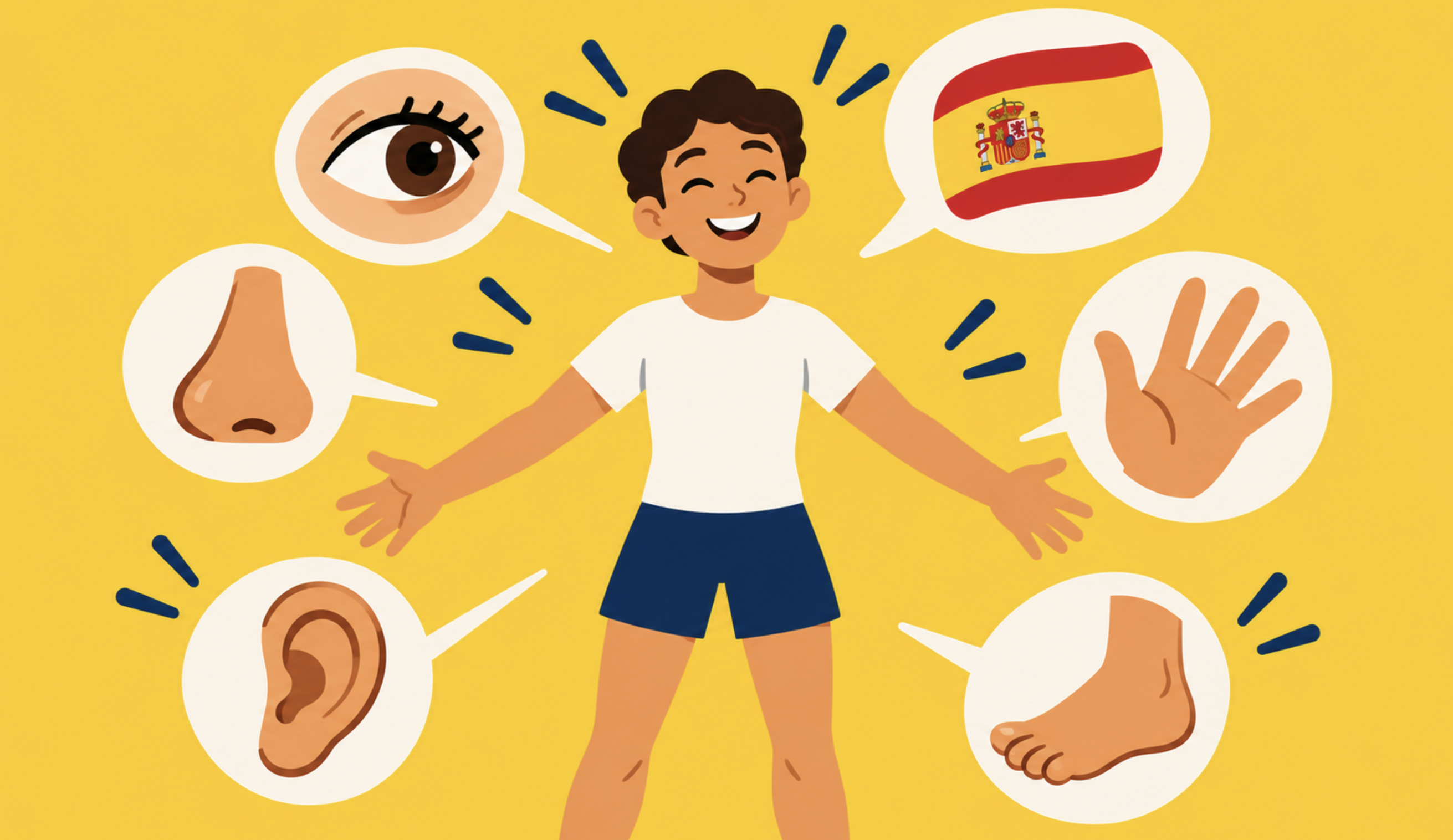
TL;DR: The Spanish word for body is “el cuerpo”, and body parts are “las partes del cuerpo”. When learning body parts in Spanish, start with the basics, such as “la cabeza” (head), “los ojos” (eyes), “la nariz” (nose), “la mano” (hand), “la pierna” (leg), and “el pie” (foot). You can then move forward to other body parts like the knee (“la rodilla”), ankle (“el tobillo”), elbow (“el codo”), wrist (“la muñeca”), and chest (“el pecho”).
Learning body parts in Spanish helps you describe people, follow instructions and explain where something hurts. Start by practising them in short sentences to make the vocabulary easier to recall and use in everyday conversations.
What are the main body parts in Spanish?
Learning the main body parts in Spanish is useful in everyday conversations, medical settings, and exercise classes. Here is a list of the main body parts to start with before expanding your vocabulary, depending on your goals:
| Spanish | English |
|
el cuerpo |
The body |
|
la cabeza |
The head |
|
el pelo/el cabello |
The hair |
|
la nariz |
The nose |
|
el ojo |
The eye |
|
la boca |
The mouth |
|
la oreja |
The outer ear |
|
el cuello |
The neck |
|
el diente |
The tooth |
|
la lengua |
The tongue |
|
el hombo |
The shoulder |
|
el brazo |
The arm |
|
la mano |
The hand |
|
el pecho |
The chest |
|
la espalda |
The back |
|
el abdomen |
The abdomen |
|
la cadera |
The hip |
|
la pierna |
The leg |
|
la rodilla |
The knee |
|
el pie |
The foot |
|
el tobillo |
The ankle |
|
la piel |
The skin |
|
el hueso |
The bone |
|
el músculo |
The muscle |
Notice that each noun in the table has an article: el or la. This is because body parts in Spanish have grammatical gender. Learn each word together with its article from the start, because the article also decides the form of any adjective you use with it. Memrise teaches vocabulary with its article attached, so you learn them both at the same time.
What are the parts of the head and face in Spanish?
Learners rely on head and face vocabulary when describing someone’s appearance or talking about grooming. Two distinctions to remember are “la oreja” (outer ear) and “el oído” (inner ear). This is especially helpful when visiting the doctor’s office because you will encounter different terminology.
| Spanish | English |
|
el pelo/el cabello |
The hair |
|
la cara |
The face |
|
la frente |
The forehead |
|
el ojo |
The eye |
|
la ceja |
The eyebrow |
|
la pestaña |
The eyelash |
|
la nariz |
The nose |
|
la mejilla |
The cheek |
|
la oreja |
The outer ear |
|
el oído |
The inner ear/hearing |
|
la boca |
The mouth |
|
el labio |
The lip |
|
el diente |
The tooth |
|
la lengua |
The tongue |
|
la barbilla |
The chin |
|
la mandíbula |
The jaw |
What are the Spanish words for arms, hands, and fingers?
Spanish words for arms, hands, and fingers help you understand instructions and describe physical actions. They are also helpful when talking about clothing, sports, or everyday activities. Here are all the upper body parts you should learn first:
- The arm: el brazo
- The shoulder: el hombro
- The elbow: el codo
- The wrist: la muñeca
- The hand: la mano
- The palm: la palma
- The finger: el dedo
- The thumb: el pulgar
- The index finger: el dedo índice
- The middle finger: el dedo corazón
- The ring finger: el dedo anular
- The little finger: el meñique
- The nail: la uña
- The armpit: la axila
For example, “Levanta la mano” translates to “Raise your hand”. You may also hear “Me duele la muñeca”, which means “My wrist hurts”. However, remember that la mano is feminine, even though it ends in -o. This is a good example of why learning grammatical gender with each noun is more reliable than guessing from the final letter.
What are the Spanish words for legs and feet?
The lower-body vocabulary covers everything from the hips to the toes. You may come across these terms when discussing exercise, walking, clothing, and discomfort. Some of the helpful vocabulary to start with includes the following:
| Spanish | English |
|
la cadera |
The hip |
|
el muslo |
The thigh |
|
la pierna |
The leg |
|
la rodilla |
The knee |
|
la pantorrilla |
The calf |
|
el tobillo |
The ankle |
|
el pie |
The foot |
|
el talón |
The heel |
|
la planta del pie |
The sole of the foot |
|
el dedo del pie |
The toe |
|
la uña del pie |
The toenail |
How do you talk about internal organs in Spanish?
Learning internal-organ vocabulary in Spanish is useful when discussing health or understanding basic medical conversations. Here is a list of commonly mentioned organs and structures to start with:
- The heart: el corazón
- The lung: el pulmón
- The liver: el hígado
- The stomach: el estómago
- The kidney: el riñón
- The intestine: el intestino
- The brain: el cerebro
- The bladder: la vejiga
- The uterus: el útero
- The throat: la garganta
- The blood: la sangre
- The spine: la columna vertebral
When learning these terms, it is useful to practise both the singular and plural forms. For instance, “el pulmón” means “the lung”, while “los pulmones” means “the lungs”. This helps you recognise the words when reading or listening. Native speaker videos in language learning apps, including Memrise, help you understand how plural and singular forms are used in everyday conversations.
Frequently asked questions
How do you describe pain in Spanish?
Spanish commonly uses the verb “doler” to describe pain, but it changes form depending on whether the body part is singular or plural. For instance, “Me duele la cabeza” means “My head hurts”, while “Me duele la rodilla” translates to “My knee hurts”. However, “Me duelen los pies” means “My feet hurt”, while “Tengo dolor de garganta” means “I have a sore throat”.
What is "body parts" in Spanish?
Body parts" in Spanish is "las partes del cuerpo", and a single body part is "la parte del cuerpo". The word "cuerpo" means "body" and is masculine ("el cuerpo"), while "parte" is feminine, which is why the article changes. Learners use the phrase when naming areas of the body, describing symptoms, or asking how to say a specific part in Spanish.
Do you say "my" with body parts in Spanish?
Usually not. When it's clear whose body part you mean, Spanish uses the definite article instead of a possessive. You say, "Me duele la cabeza" (my head hurts), not "Me duele mi cabeza", and "Me lavo las manos" (I wash my hands), not "Me lavo mis manos". In these examples, the pronoun "me" already tells you who the head and the hands belong to.