

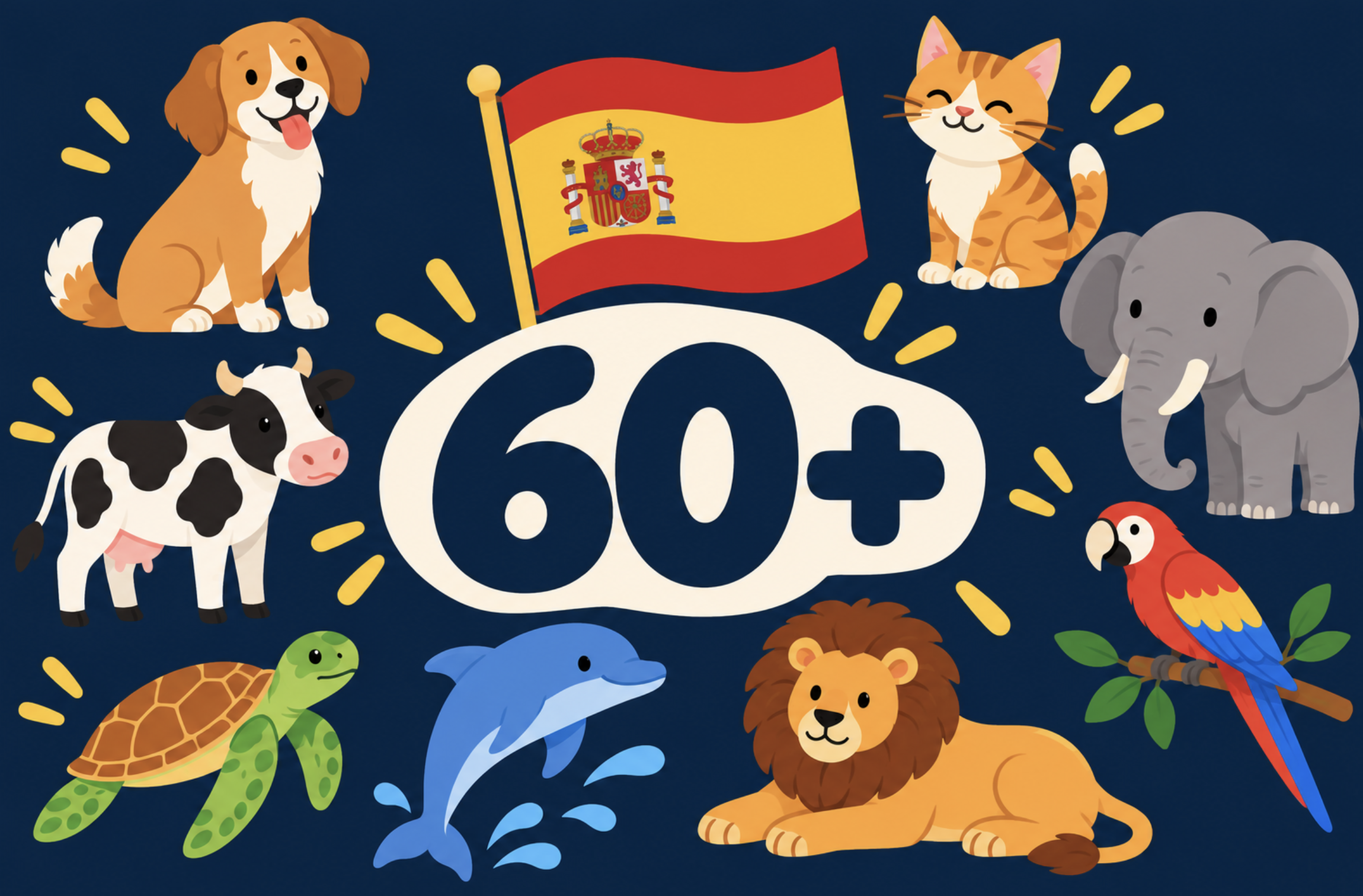
TL;DR: Animal words are among the first that most learners come across. The Spanish word for animal is animal, pronounced approximately ah-nee-MAHL, and its plural is animales. Spanish animal nouns should always be learned with their articles because each has a grammatical gender. That gender does not always reveal whether the animal itself is male or female, which can be confusing for learners.
Animal vocabulary appears in conversations about pets and time spent outside. Many learning materials choose to include animals in the early stages to build this foundational knowledge. This guide provides the Spanish names, approximate pronunciations, and grammar needed to use them correctly.
What are the most useful animal names in Spanish?
The most useful Spanish animal names include familiar pets and farm animals. The focus should be on wildlife likely to appear in everyday conversations. The word pangolin is less likely to come up than dog. Learning them by category creates useful associations, while including el or la helps learners remember each noun’s grammatical gender. Because the article is part of the word, it is worth learning el perro rather than perro from the first day. Memrise presents each noun with its article attached, so the gender arrives with the word instead of having to be learned separately afterwards.
The main table below contains 65 animals. Its pronunciation guides are approximations for English speakers. It is crucial to practise these words in natural conversations in order to learn exactly how they should be spoken.
| English | Spanish with article | Beginner pronunciation | Category |
| Dog | el perro | PEH-rroh | Pet |
| Cat | el gato | GAH-toh | Pet |
| Fish | el pez | pehs | Pet |
| Rabbit | el conejo | koh-NEH-hoh | Pet |
| Hamster | el hámster | AHM-stehr | Pet |
| Guinea pig | la cobaya | koh-BAH-yah | Pet |
| Mouse | el ratón | rrah-TON | Pet |
| Turtle | la tortuga | tor-TOO-gah | Pet |
| Parrot | el loro | LOH-roh | Pet |
| Horse | el caballo | kah-BAH-yoh | Farm |
| Cow | la vaca | BAH-kah | Farm |
| Bull | el toro | TOH-roh | Farm |
| Pig | el cerdo | SEHR-doh | Farm |
| Sheep | la oveja | oh-BEH-hah | Farm |
| Goat | la cabra | KAH-brah | Farm |
| Chicken | el pollo | POH-yoh | Farm |
| Hen | la gallina | gah-YEE-nah | Farm |
| Rooster | el gallo | GAH-yoh | Farm |
| Duck | el pato | PAH-toh | Farm |
| Goose | el ganso | GAHN-soh | Farm |
| Donkey | el burro | BOO-rroh | Farm |
| Turkey | el pavo | PAH-boh | Farm |
| Lion | el león | leh-ON | Wild or zoo |
| Tiger | el tigre | TEE-greh | Wild or zoo |
| Elephant | el elefante | eh-leh-FAHN-teh | Wild or zoo |
| Giraffe | la jirafa | hee-RAH-fah | Wild or zoo |
| Bear | el oso | OH-soh | Wild or zoo |
| Monkey | el mono | MOH-noh | Wild or zoo |
| Gorilla | el gorila | goh-REE-lah | Wild or zoo |
| Zebra | la cebra | SEH-brah | Wild or zoo |
| Wolf | el lobo | LOH-boh | Wild or zoo |
| Fox | el zorro | SOH-rroh | Wild or zoo |
| Deer | el ciervo | SYEHR-boh | Wild or zoo |
| Squirrel | la ardilla | ar-DEE-yah | Wild or zoo |
| Kangaroo | el canguro | kahn-GOO-roh | Wild or zoo |
| Camel | el camello | kah-MEH-yoh | Wild or zoo |
| Rhinoceros | el rinoceronte | ree-noh-seh-RON-teh | Wild or zoo |
| Hippopotamus | el hipopótamo | ee-poh-POH-tah-moh | Wild or zoo |
| Crocodile | el cocodrillo | koh-koh-DREE-loh | Wild or zoo |
| Shark | el tiburón | tee-boo-RON | Marine |
| Whale | la ballena | bah-YEH-nah | Marine |
| Dolphin | el delfín | del-FEEN | Marine |
| Seal | la foca | FOH-kah | Marine |
| Octopus | el pulpo | POOL-poh | Marine |
| Squid | el calamar | kah-lah-MAHR | Marine |
| Jellyfish | la medusa | meh-DOO-sah | Marine |
| Crab | el cangrejo | kahn-GREH-hoh | Marine |
| Lobster | la longosta | lahn-GOS-tah | Marine |
| Penguin | el pingüino | peen-GWEE-noh | Marine |
| Starfish | le estrella de mar | ehs-TREH-yah deh mahr | Marine |
| Eagle | el águila | AH-gee-lah | Bird |
| Owl | el búho | BOO-oh | Bird |
| Pigeon or dove | la paloma | pah-LOH-mah | Bird |
| Swan | el cisne | SEES-neh | Bird |
| Seagull | la gaviota | gah-BYOH-tah | Bird |
| Flamingo | el flamenco | flah-MEHN-koh | Bird |
| Ostrich | el avestruz | ah-behs-TROOS | Bird |
| Snake | la serpiente | sehr-PYEN-teh | Reptile |
| Lizard | el lagarto | lah-GAHR-toh | Reptile |
| Frog | la rana | RRAH-nah | Amphibian |
| Toad | el sapo | SAH-poh | Amphibian |
| Butterfly | la mariposa | mah-ree-POH-sah | Insect |
| Bee | la abeja | ah-BEH-hah | Insect |
| Spider | la araña | ah-RAH-nyah | Arachnid |
| Ant | la hormiga | or-MEE-gah | Insect |
How are Spanish animal names pronounced?
Several Spanish animal words contain sounds that English does not reproduce precisely. Therefore, Spanish animal names are best learned through native-speaker audio rather than English pronunciation guides and text alone.
The rolled or tapped r sound distinguishes perro from similar-looking words. The j in jirafa is pronounced at the back of the mouth. The ñ in araña sounds broadly like ny. In many accents, ll in caballo resembles an English y, although regional pronunciations differ.
These subtle changes can get confusing. Memrise pairs vocabulary with native-speaker video, which allows learners to hear these words in real accents instead of depending on phonetic approximations.
Are Spanish animal names masculine or feminine?
Every Spanish animal noun has a grammatical gender. Its gender does not identify the animal’s biological sex. Some words change their ending. A rabbit in Spanish can be el conejo or la coneja, while a duck in Spanish may be el pato or la pata.
Other animals use different words. A horse in Spanish is normally el caballo, but a mare is la yegua. Fixed-gender nouns behave differently again. The usual word for a snake in Spanish is la serpiente even when the snake is male. Use la serpiente macho when its biological sex matters.
| Pattern | Male form | Female form | Meaning |
| Ending changes | el perro | la perra | dog |
| Ending changes | el conejo | la coneja | rabbit |
| Ending changes | el pato | la pata | duck |
| Different nouns | el caballo | la yegua | horse/mare |
| Different nouns | el toro | la vaca | bull/cow |
| Different nouns | el gallo | la gallina | rooster/hen |
| Fixed noun | la serpiente macho | la serpiente hembra | male/female snake |
| Fixed noun | la jirafa macho | la jirafa hembra | male/female giraffe |
How do you use Spanish animal words in sentences?
Use Spanish animal nouns with the appropriate article and be sure to make descriptive words agree with them. Useful beginner examples include:
- Tengo un perro negro: I have a black dog
- La serpiente es larga: the snake is long
- El caballo vive en la granja: the horse lives on the farm
- Vimos dos leones en el zoológico: we saw two lions at the zoo
What other Spanish words help when talking about animals ?
There are several terms that relate to animals. These inevitably come up when talking about other creatures. Useful related vocabulary includes granja for farm and zoológico for zoo. These words make it easier to discuss animals in context.
| English | Spanish | Beginner pronunciation |
| Animal | el animal | ah-nee-MAHL |
| Animals | los animales | ah-nee-MAH-les |
| Pet | la mascota | mahs-KOH-tah |
| Vet | el veterinario/la veterinaria | beh-teh-ree-NAH-ryoh/ryah |
| Farm | la granja | GRAHN-hah |
| Zoo | el zoológico | soh-oh-LOH-hee-koh |
| Habitat | el hábitat | AH-bee-taht |
| Stable | el establo | ehs-TAH-bloh |
| Aquarium | el acuario | ah-KWAH-ryoh |
| Species | la especie | ehs-PEH-syeh |
| Herd | la manada | mah-NAH-dah |
Frequently asked questions
What is the difference between animal and mascota?
Animal is the general word for an animal. Mascota means a pet. A lion, a farm animal, or a household dog can all be described as an animal, but mascota normally refers to an animal kept for companionship. Animal doméstico may mean a domesticated or domestic animal more broadly.
Do animal names change for male and female animals in Spanish?
Some Spanish animal names change for sex. Others do not. Forms such as conejo/coneja change their endings, but caballo/yegua use separate words. Fixed nouns such as serpiente usually retain their grammatical gender and add macho or hembra when clarification is necessary.
What is the best way to memorise animals in Spanish?
The best method is to learn animals in categories, together with their articles and spoken pronunciation. Connect each word to an image and use it in a short sentence. Active recall is more demanding than rereading a list, but it confirms whether the Spanish word can be produced independently.