Select page language

- Languages
- Learn Arabic
- Learn Chinese
- Learn Japanese
- Learn Russian
- Learn Danish
- Learn Korean
- Learn Slovenian
- Learn Dutch
- Learn Mongolian
- Learn Spanish
- Learn French
- Learn Norwegian
- Learn Swedish
- Learn German
- Learn Polish
- Learn Turkish
- Learn Icelandic
- Learn Portuguese
- Learn Yoruba
- Learn Italian
- Learn Indonesian
- Learn Greek
- Learn Thai
- Learn Hindi
- Learn Hebrew
- Learn Ukrainian
- Learn Persian
- Learn Swahili
- Learn Galician
- Learn Welsh
- Learn Somali
- Learn Hausa
- Learn Igbo
- Learn IsiXhosa
- Learn Afrikaans
- Learn Latin
- Learn Finnish
- Learn Irish
- Learn Ancient Greek
- Learn Czech
- Learn Hungarian
- Learn Cantonese
- Learn Romanian
- Learn Esperanto
- Learn Croatian
- Learn Kurdish
- Learn Serbian
- Learn Bulgarian
- Learn Malay
- Learn Māori
- Learn Albanian
- Learn Lithuanian
- Learn Catalan
- Learn Georgian
- Learn Sanskrit
- Learn Bengali
- Learn Estonian
- Learn Nepali
- Learn Scottish Gaelic
- Learn Slovak
- Learn Azerbaijani
- Learn Latvian
- Learn Basque
- Learn Punjabi
- Learn Zulu
- Learn Khmer
- Learn Tibetan
- Learn Hakka
- Learn Bosnian
- Learn Dovahzul
- Learn Greenlandic
- Learn Scots
- Learn Cebuano
- Learn Luxembourgish
- Learn Kazakh
- Learn Pashto
- Learn Toki Pona
- Learn Cornish
- Learn Burmese
- Learn Quenya
- Learn Malayalam
- Learn Amharic
- Learn Lakota
- Learn Macedonian
- Learn Akan-Twi
- Learn Na'vi
- Learn Lojban
- Learn Maltese
- Learn Yiddish
- Learn Faroese
- Learn Hawaiian
- Learn Flemish
- Learn Kyrgyz
- Learn Quechua
- Learn Klingon
- Learn Gujarati
- Learn Aramaic
- Learn Belarusian
- Learn Anglo-Saxon
- Learn Pali
- Learn Cherokee
- Learn Marathi
- Learn Lingala
- Learn Breton
- Learn Wolof
- Learn Kinyarwanda
- Learn Choctaw
- Learn Haitian
- Learn Gothic
- Learn Coptic
- Learn Malagasy
- Learn Inuktitut
- Learn Guaraní
- Learn Ossetic
- Learn Marshallese
- Learn Eastern Armenian
- Learn Western Armenian
- Learn Luganda
- Learn Ainu
- Learn Circassian
- Learn Javanese
- Learn Sinhala
- Learn Mandinka
- Learn Manx
- Learn Australian Languages
- Learn Creek
- Learn Tatar
- Learn Ladino
- Learn Dzongkha
- Learn Soninke
- Learn Alutiiq
- Learn Potawatomi
- Learn Nyanja
- Learn Tamang
- Learn Kaonde
- Learn Ningbo
- Courses
- Phrasebooks
- Memrise blog

Spanish Pronunciation Guide: Vowels, Consonants, Stress and the Sounds English Speakers Get Wrong
TL;DR: Spanish is one of the most phonetic languages you can learn. Once you know the rules, the words are pronounced almost exactly as they are written, with very few silent letters. The five vowels (a, e, i, o, u) are short, pure and never change. Most consonants behave like their English counterparts. The ones that trip people up are the tapped and rolled r/rr, the throaty j and soft g, the silent h, ñ, ll/y, and the c/z sounds that differ between Spain and Latin America. Stress is predictable, and a written accent (á, é, í, ó, ú) tells you exactly where to put the emphasis. Study the tables below, practise out loud, and review little and often until the sounds become automatic.
This guide covers everything you need to read a Spanish word and say it correctly: the vowels, the consonants that differ from English, stress and accent rules, the mistakes English speakers make most often, and how to practise so it sticks. Where it helps, we have included the International Phonetic Alphabet (IPA) symbol alongside a plain-English example.
A quick note before we start. Spanish is spoken across more than 20 countries, and
pronunciation varies. We flag the main differences between European (Castilian) Spanish and Latin American Spanish as they come up, so you will never be caught out. And if you would rather hear those differences than read about them, Memrise’s library of over 72,000 native speaker videos spans accents from across Spain and Latin America, so you can tune your ear to the region you are actually learning for.
Why Spanish pronunciation is easier than you think
English is a spelling nightmare: "though", "through" and "tough" all end in "-ough" but sound completely different. Spanish does not work like this. The relationship between letters and sounds is consistent, so once you have learned a rule, it applies nearly every time.
Three facts make the whole system click:
English has roughly a dozen vowel sounds; Spanish has only five.
2. Almost nothing is silent. The main exception is the letter h, which is always silent, and the u
in que, qui, gue and gui.
3. Stress is rule-based. You can look at a written word and know which syllable to emphasise,
because the spelling (and any accent mark) tells you.
This is the good news. The work is in the handful of consonants that do not map neatly onto
English, plus training your ear and mouth to produce sounds like the rolled rr.
The five Spanish vowels
This is the single most important section. If you get the vowels right, you will sound clear and natural even when your grammar is shaky. Keep them short and crisp. The most common English-speaker mistake is to let a vowel "glide" into a second sound, such as the way "o" in English "go" drifts towards "oh-oo". In Spanish, a vowel is one clean sound that is held briefly and released.
| Vowel | IPA | Sounds like (English) | Example word | Tip |
| a | /a/ | "a" in father | casa (house) | Open your mouth a little wider than feels natural. |
| e | /e/ | "e" in bet (or café without the glide) |
mesa (table) | Keep it tight; do not let it slide towards "ay". |
| i | /i/ | "ee" in machine | día (day) | A pure "ee"; smile slightly. |
| o | /o/ | "o" in or / more | todo (all) | Round your lips; do not let it drift to "ow". |
| u | /u/ | "oo" in flute | uno (one) | Push your lips forward into a small circle. |
Vowel combinations (diphthongs)
When two vowels sit together, Spanish often blends them into a single syllable. The "weak" vowels are i and u; the "strong" vowels are a, e and o.
● A weak vowel next to a strong vowel glides into it: bien (well) is one syllable, cuatro (four) starts with a "kwa" sound.
● Two strong vowels stay as separate syllables: museo (museum) is mu-se-o.
● A written accent on a weak vowel breaks the diphthong and makes it its own syllable: día is dí-a, país (country) is pa-ís.
Consonants that differ from English
Most consonants (m, n, p, f, l, s, t, k) are close enough to English that you can carry on as normal. The table below covers the ones that genuinely differ. Take note that a few of these
depend on the letter that follows or on the region.
| Letter | IPA | Sound | Example | Tip |
| h | (silent) | No sound at all | hola (hello) → "OH-la" |
Never pronounce it. Ever |
| j | /x/ | Throaty "h", like clearing your throat |
jamón (ham) | Friction at the back of the mouth, harder than English "h". |
| g (+ e, i) | /x/ | Same throaty sound as j |
gente (people) | ge/gi sound like je/ji. |
| g (+ a, o, u) | /ɡ/ | Hard "g" as in go |
gato (cat) | Normal English hard g. |
| gu (+ e, i) | /ɡ/ | Hard "g"; the u is silent |
guitarra (guitar) | The u is just there to keep the g hard. |
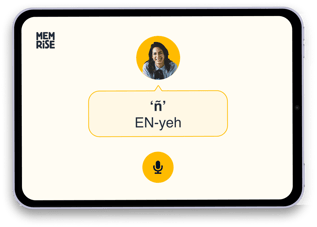
| ñ | /ɲ/ | "ny" in canyon | español (Spanish) |
One sound, not "n" + "y". |
| ll | /ʝ/ | "y" in yes (most regions) |
llamar (to call) | See note below |
| y | /ʝ/ | "y" in yes | ya (already) | As a standalone word (y = "and") it is "ee". |
| r | /ɾ/ | A quick tap | pero (but) | Like the "tt" in American butter. |
| rr | /r/ | A rolled trill | perro (dog) | Vibrate the tongue tip against the ridge behind your teeth. |
| b / v | /b/ ~ /β/ | Identical to each other |
vivir (to live) | No English "v" sound; both are a soft "b". |
| d | /d/ ~ /ð/ | Soft "th" between vowels |
nada (nothing) | Between vowels, like "th" in this. |
| c (+ e, i) | /θ/ or /s/ | "th" (Spain) or "s" (Latin America) |
cinco (five) | See note below. |
| z | /θ/ or /s/ | "th" (Spain) or "s" (Latin America) |
zapato (shoe) | Matches the c + e/i rule. |
| c (+ a, o, u) | /k/ | Hard "k" | casa (house) | Same as English hard c |
| qu | /k/ | Hard "k"; the u is silent |
queso (cheese) | que = "keh", not "kweh". |
The r and rr: the sound worth practising most
This is the consonant English speakers find hardest, and the one that most changes how native you sound.
- A single r between vowels or at the end of a word is a tap (/ɾ/): the tongue bounces once off the ridge behind your top teeth. English speakers already make this sound in the middle of "butter" or "ladder" (in American English). Say "pot of tea" quickly and the "t" becomes close to a Spanish tap.
- A double rr, or a single r at the start of a word (rojo, red) or after l, n or s, is a trill (/r/). It uses several rapid taps, so the tongue vibrates. Start by repeating a soft "d-d-d-d" behind the teeth and gradually relax the tongue until it flutters.
The contrast matters because it changes meaning: pero (but) versus perro (dog); caro
(expensive) versus carro (cart/car). Mastering this takes most learners weeks of daily practice, so do not be discouraged.
b and v sound exactly the same
There is no English-style "v" (with your teeth on your lip) in Spanish. Both b and v are pronounced as a "b". At the start of a phrase or after m/n, it is a firm "b" (/b/), as in vamos. Between vowels it softens, with the lips barely touching (/β/), as in uva (grape). Spanish speakers genuinely cannot tell b and v apart by ear, which is why even natives sometimes ask "¿con b o con v?" when spelling.
h is always silent
The letter h is never pronounced. Hola is "OH-la", hospital is "os-pee-TAL", zanahoria (carrot) glides straight through the h. The only time that h makes a sound is in the combination ch (chico, boy), which is pronounced like the "ch" in English "church".
c, z and the Spain vs Latin America split (seseo and distinción)
This is the biggest regional difference, and both versions are completely correct.
● Distinción (most of Spain): z, and c before e or i, are pronounced /θ/, like the "th" in "think". So cinco is "THIN-ko" and gracias ends in " thias".
● Seseo (Latin America, the Canary Islands and parts of southern Spain): these same letters are pronounced /s/, like a normal "s". So cinco is "SIN-ko" and gracias ends in "-sias".
Choose the pronunciation that matches the region you are learning for and stay consistent. Neither is "the correct one"; seseo covers far more speakers worldwide, while distinción is standard in central and northern Spain.
ll and y (yeísmo)
Traditionally ll was a separate sound (/ʎ/, a "ly" sound), but more than 90% of Spanish speakers today merge it with y, pronouncing both like the "y" in "yes" (/ʝ/). This merger is called yeísmo. So llave (key) and yo (I) start with the same sound for most speakers.
The notable exception is the Río de la Plata region (Argentina and Uruguay), where ll and y are pronounced like the "sh" in "shoe" or the "s" in "measure" (/ʃ/ or /ʒ/). So a porteño from Buenos Aires says yo closer to "sho". This is called sheísmo / zheísmo, and it is a quick way to spot a River Plate accent.
Stress and accent marks
Stress in Spanish is refreshingly logical. There are two default rules and one override.
Rule 1, for words ending in a vowel, n or s: stress falls on the second-to-last syllable.
● ca-sa (house), ha-bla-mos (we speak), jo-ven (young).
Rule 2, for words ending in any other consonant: stress falls on the last syllable.
● ha-blar (to speak), Ma-drid, fe-li-ci-dad (happiness).
The override, the written accent (á, é, í, ó, ú): if a word has an accent mark, ignore the rules
above and stress the marked vowel.
● es-ta-ción (station), rá-pi-do (fast), in-glés (English), a-zú-car (sugar).
The accent always wins. It exists precisely to mark the exception to the two default rules, so a written accent is a gift: it removes all guesswork.
Accents that change meaning
Some accents do not mark stress at all; they distinguish two otherwise identical-looking words from one another. These are worth memorising:
| Without accent | With accent |
| el (the) | él (he) |
| si (if) | sí (yes) |
| tu (your) | tú (you) |
| mas (but, literary) | más (more) |
| te (you, object) | té (tea) |
| que (that) | qué (what?) |
Question words such as qué, cómo, cuándo, dónde and por qué have an accent when asking a question, and drop it otherwise.
The tilde over ñ is not an accent; it creates a completely different letter. Año (year) and ano
(anus) are different words, so the tilde matters.
Common mistakes English speakers make
These are the habits that signal an English accent, in rough order of how often they appear:
4. Gliding the vowels. Saying no as "noh-oo" or café as "ka-fay". Keep vowels short and flat.
5. Pronouncing the h. Hotel is "o-TEL", not "ho-tel".
6. Using an English "v". Vino (wine) starts with a "b", not a teeth-on-lip "v".
7. Aspirating p, t and k. In English we release a little puff of air after these (hold your hand to
your mouth and say "pot"). In Spanish they are crisp and puff-free. Patata should have no
breathiness.
8. Reducing unstressed vowels to "uh". English turns unstressed vowels into a lazy schwa
("banana" = "buh-NAN-uh"). Spanish keeps every vowel full and clear: banana is "ba-NA-na".
9. Making the d too hard. Between vowels, d softens towards "th". Madrid and nada are
softer than they look.
10. Skipping the tap/trill distinction. Using one English "r" for both pero and perro. It is
worthwhile to practise using both.
11. Putting stress in the English place. English speakers often stress the wrong syllable. Trust
the rules above instead of guessing.
How to practise so it sticks
Knowing the rules is not the same as producing the sounds automatically. Here are a few practical methods to master learning, from most to least important:
● Shadowing. Play a short clip of a native speaker and repeat it immediately, copying the rhythm and melody, not just the words. Even 5 10 minutes a day helps to build muscle memory quickly. Memrise's Learn with Locals clips are designed for exactly this as they feature real native speakers saying real phrases, and with 72,000+ of them across a range of accents, you can shadow the variety of Spanish you are actually learning.
● Well-timed review. Review sounds and example words at increasing intervals so they move into long-term memory. This is the principle behind Memrise's review system: it brings a word back just as you are about to forget it.
● Record yourself. Say a sentence, record it, then play it next to a native clip. The gap you hear is your to-do list. Memrise builds this loop into the app: its pronunciation feature
listens to you and scores how close you got, and with more than 611,000 audio recordings
to model from, you can replay a word as many times as you need before attempting it yourself.
● Drill the rolled rr in isolation. Practise r sounds separately from full sentences. Try erre con erre cigarro (a classic tongue-twister) once you have the basic trill.
● Read aloud. Since Spanish is phonetic, reading out loud trains your eyes and mouth together. Pick a short article and read a paragraph a day.
● Learn a few minimal pairs. Practising pero/perro, caro/carro and casa/caza sharpens the exact distinctions that matter.
● Build up to real conversations. Sounds practised in isolation still need to survive a real exchange. A low-pressure middle step helps: MemBot, Memrise’s AI conversation partner, lets you speak through everyday scenarios, such as ordering a coffee or introducing yourself, and get feedback before you try it with an actual person.
Consistency beats intensity. Just 10 minutes a day will take you further than a two-hour session once a week, because pronunciation is a physical skill, like a sport.
Frequently asked questions
How do you pronounce Spanish words correctly?
Read the letters using the consistent sound rules (the five pure vowels, the silent h, the throaty j, and so on), then apply the stress rules: stress the second-to-last syllable for words ending in a vowel, n or s, the last syllable otherwise, and the marked vowel if there is a written accent. As Spanish is highly phonetic, the spelling tells you almost everything you need to know.
What is the 80/20 rule in Spanish?
This is the idea that a small portion of the language delivers most of the results: roughly the 20% most common words and patterns let you understand about 80% of everyday speech. For pronunciation, the equivalent is that mastering the five vowels and a handful of tricky consonants (r/rr, j, ñ, ll/y, c/z) covers the vast majority of words you will ever say.
Is Spanish pronunciation the same everywhere?
No, but the core is the same. The main regional differences are seseo versus distinción (whether
c/z sound like "s" or "th"), yeísmo (how ll and y are pronounced), and the River Plate "sh" sound. The vowels and stress rules are the same across all regions, so once you have mastered those, you will be understood everywhere.
How long does it take to get good at Spanish pronunciation?
Most learners can produce clear, understandable Spanish within a few weeks of daily practice, because the vowel system is simple. The rolled rr is usually the last piece to fall into place and can take a couple of months. Daily shadowing and regular review speed this up considerably.
Which is harder to pronounce, Spanish or French?
For English speakers, Spanish is generally easier. It has fewer vowel sounds (five versus around a dozen in French), no nasal vowels, and a far more consistent letter-to-sound relationship. French has more silent letters and trickier vowels. The one Spanish sound that takes real practice is the rolled rr.
Where to go next
Pronunciation is the foundation, but it works best when it is tied to real vocabulary and real
speakers. Build a daily habit, lean on native-speaker clips, and let Memrise do the remembering for you. Words in Memrise’s Learn feature come with phonetic spellings so you can say them with confidence from the first encounter, and 1,249 ‘Did you know?’ nuggets explain the etymology and cultural quirks behind why words sound the way they do, including why that h in hola is silent. Start with the five vowels until they are automatic, then layer in the tricky consonants one at a time. The rolled rr will come; everyone struggles with it at first.