

English Level Test – Discover Your Real Level Free in 10 Minutes
Not sure if you're B1 or B2? Planning to take IELTS or a job interview in English, but don't know where to start studying?
Most free online English tests are just grammar quizzes. They don't check your real level – whether you actually understand native speakers or can communicate in real situations.
Our interactive level assessment on Memrise shows you what you can do at each CEFR level (A1-C2) – from basic conversations (A1) to business presentations (C1). In just 10 minutes, you'll confirm your current level across four skills: listening, reading, speaking, and writing.

Join over 12,000 learners who've already mapped their English learning journey.
If you're accessing from other languages, follow the links below:
What Is the CEFR Scale and Why Should You Know Your Level?
The CEFR (Common European Framework of Reference) is the international standard for assessing language ability. Recognized by employers, universities, and exam institutions worldwide.
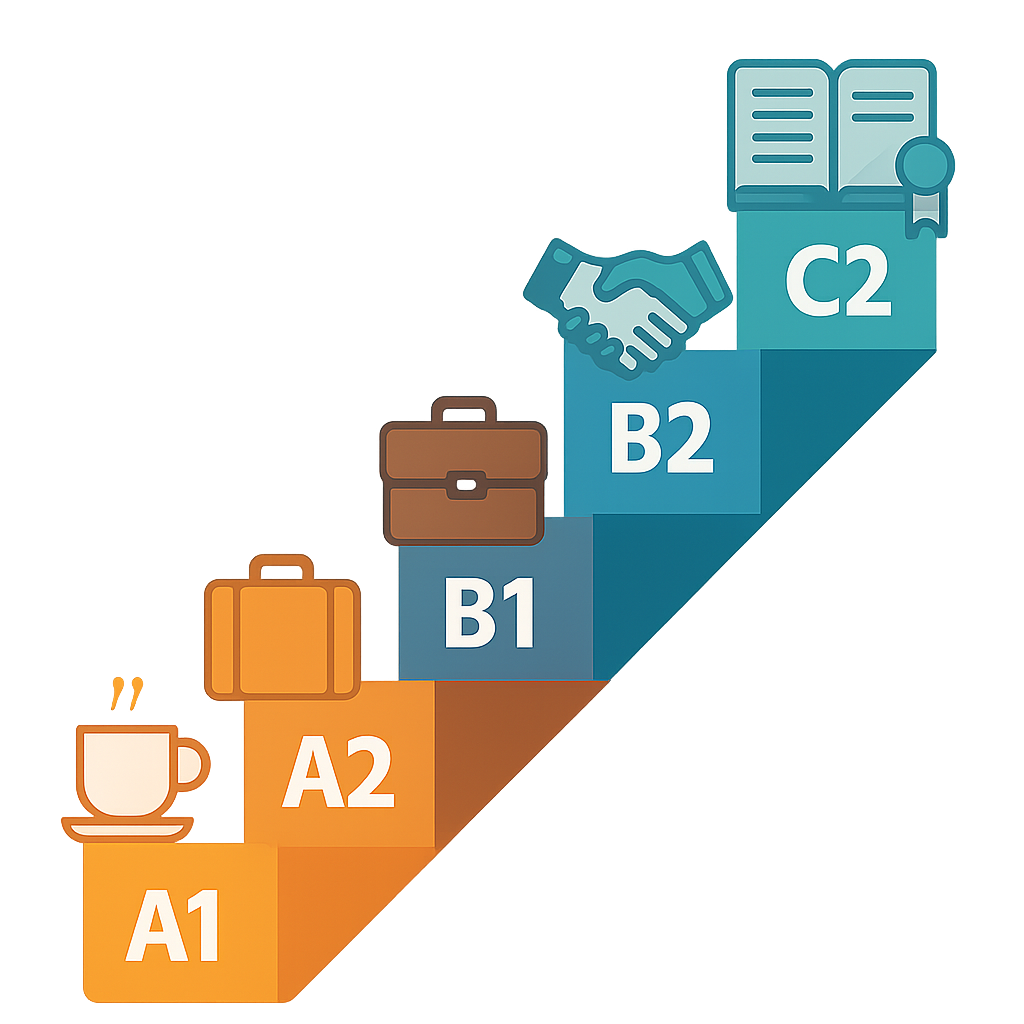
CEFR Levels – What You Can Actually Do at Each Level
Level A1 (Beginner)
- You understand: Basic expressions, simple questions spoken slowly and clearly
- You can: Introduce yourself, ask for directions, order coffee
- Example: "Hello, my name is..." / "Where is the toilet?"
- You CANNOT: Understand radio, TV, normal conversations between native speakers
Level A2 (Elementary)
- You understand: Simple everyday situations, shopping, basic personal information
- You can: Describe your family, work, interests with simple sentences
- Example: "I work in a bank. I like reading."
- You CANNOT: Have conversations about abstract topics, watch films without subtitles
Level B1 (Intermediate Lower)
- You understand: Main points of clear conversations about work, school, hobbies
- You can: Survive while traveling, describe experiences and plans
- Example: Talk about vacations, describe a problem at a hotel
- You CANNOT: Discuss complex topics fluently, negotiate contracts
Level B2 (Intermediate Upper) ← Minimum for most jobs
- You understand: Main ideas of complex texts, TV news programs
- You can: Speak fluently with native speakers, defend your opinion
- Example: Job interview, discuss current events
- You CANNOT: Perfectly understand fast conversations between native speakers, use advanced slang
Level C1 (Advanced)
- You understand: Long, demanding texts, films, nuances of meaning
- You can: Use language flexibly in work and social life
- Example: Business presentations, negotiations, write reports
- Difficulty: Native idioms, regional humor
Level C2 (Mastery) ← Native speaker level
- You understand: Practically everything spoken and written
- You can: Express subtle nuances, write complex texts
- Example: Work as translator, lecturer, writer in English
.png?width=2816&height=1536&name=Gemini_Generated_Image_gbkkwqgbkkwqgbkk%20(1).png)
What English Level Do You Need? Guide by Goals
English Level for Work
Customer service/Call center: Minimum B2 (must understand native speakers over the phone)
International team: B2-C1 (video conferences, emails, fluent conversation)
Management position: C1 (negotiations, presentations, leading meetings)
Remote work for foreign company: Minimum B2, C1 recommended (all communication in English)
English Level for Study Abroad
Bachelor's degree (UK, USA): Minimum B2 (IELTS 6.0-6.5 / TOEFL 80-90)
Master's degree: C1 (IELTS 6.5-7.0 / TOEFL 90-100)
MBA, law, medicine: C1-C2 (IELTS 7.0+ / TOEFL 100+)
English Level for Immigration
Work visa (Australia, Canada): Usually minimum B2 in certified test
Working abroad: B2-C1 depending on profession
Daily life abroad: B1 enough to start, but B2 needed for real integration
How to Check Your English Level? Method Comparison
Cambridge Exams (FCE, CAE, CPE)
Time: 3-4 hours
Cost: $200-300
Validity: Forever
When worth it: You need official certificate for CV, university, visa
Downside: Expensive, stressful, must study "for the exam"
IELTS / TOEFL
Time: 3-4 hours
Cost: $250-350
Validity: 2 years
When worth it: Applying to UK/USA university, Australia/Canada visa
Downside: Very expensive, result "expires" after 2 years
Tests at Language Schools
Time: 1-2 hours
Cost: $50-150 or free for students
When worth it: Want to know which course to enroll in
Downside: Often inflate level to sell more expensive class
Free Online Tests (EF SET, Cambridge Online)
Time: 30-50 minutes
Cost: Free
When worth it: First orientational assessment
Downside: Only reading and grammar, no listening with native speakers
Memrise Level Assessment (Recommended for Quick Assessment)
Time: 10 minutes
Cost: Free
When worth it: Want to quickly know real level before enrolling in course or exam
Advantage: Shows what you can do at each level across 4 skills, results saved in profile to track progress
.png?width=10416&height=7454&name=Group%2040144%20(1).png)
How the Memrise Level Assessment Works
Unlike traditional tests that only show a numerical result, our tool guides you step by step:
Step 1: Explore the Levels (3 minutes)
Before assessment, you see clear descriptions of what you can do at each CEFR level:
- A1 Listening: "I can recognize familiar words and very basic phrases concerning myself, my family and immediate surroundings when people speak slowly and clearly."
- B2 Speaking: "I can interact with a degree of fluency and spontaneity that makes regular conversation with native speakers possible."
- C1 Writing: "I can write clear, well-structured texts on complex subjects."
This helps you understand what each level really means before assessment.
Step 2: Guided Self-Assessment (7 minutes)
For each skill (listening, reading, speaking, writing), you select the level that best describes what you can currently do.
This isn't a surprise test – it's a guided reflection process that helps you be honest about your real level.
Step 3: Your Personal Learning Map
You receive a clear profile showing:
- Your level in each skill
- Where your strengths are (e.g., reading B2, listening B1)
- What you need to improve to reach the next level
- Recommended path for preparing official exams
Why This Method Is More Honest Than Traditional Tests
Traditional tests: Ask you questions, calculate result, you're surprised (positively or negatively).
Our method: First you understand what each level means with concrete examples, then you honestly assess where you are.
Result: More accurate assessment because you're not guessing – you're comparing your real abilities with clear CEFR descriptors.
Most Common Mistakes in Assessing Your Own Level
"I Have B2 Because I Finished B2 Course"
Finishing B2 course ≠ having B2 level.
Most schools pass students to the next level after reaching 60-70% of material. In reality you might be at B1+ and get a B2 certificate.
"I Understand Everything When Someone Speaks Slowly"
That's not your real level. Native speakers won't speak slowly in real conversation, at work, in a film.
If you need the speaker to slow down, your level is half a grade below what you think.
"I Read Well, So I'm B2"
Reading is the easiest skill – you can read at your own pace, go back to the sentence, look up a word in the dictionary.
Real level = listening + speaking. Most learners have reading one level above listening.
"I Did a Grammar Test and Got B2"
Grammar is just one element. You can know all the tenses and still not understand "I'm knackered" (British slang = "I'm exhausted").
How to Prepare for Cambridge, IELTS, or TOEFL
Step 1: Check Your Real Level (10 Minutes)
Don't guess – do the assessment. If you're at B1 and planning IELTS (B2) in 3 months, you won't pass. You need a real assessment.
Step 2: Plan a Realistic Timeline
- From A2 to B1: 6-12 months of intensive study
- From B1 to B2 (IELTS 6.0-6.5): 6-9 months
- From B2 to C1 (IELTS 7.0+): 9-12 months
- From C1 to C2: 12+ months
This is with 5-7 hours per week. If you only study 2 hours/week, double these times.
Step 3: Fill Gaps, Don't Study "For the Exam"
Biggest mistake: Buy "IELTS Practice Tests" book and do tests continuously.
Better:
- See where you have gaps (vocabulary? accents? speed?)
- Learn with native speakers (Memrise, podcasts, series)
- Do practice test only when you feel more confident
Step 4: Track Progress Monthly
Repeat assessment every 4 weeks. If you don't see progress, change study method.
Frequently Asked Questions
How long does the English level test take?
10 minutes. You don't need to block the whole afternoon like with Cambridge or IELTS. You can do it during a coffee break, in the evening before bed.
Is the test really free?
Yes. Create a free Memrise account, click "Check level" and get your result. We don't ask for a credit card.
Why do I need to create an account?
To provide an accurate assessment, we save your results in your personal Memrise profile. This allows you to:
- See your level in 4 skills (listening, reading, speaking, writing)
- Receive personalized learning recommendations
- Repeat the assessment later to measure progress
- Access Memrise courses suited to your level
Creating an account is free and takes 30 seconds – just email and password.
How often can I repeat the assessment?
Whenever you want, but we recommend at least a month between assessments. Real progress in language takes time – if you repeat every week, you'll be frustrated by lack of change.
Is the result recognized by employers or universities?
The assessment uses the CEFR scale, the same as Cambridge and IELTS. It's not an official certificate (for visa you need Cambridge/IELTS), but you can show the result to an employer as an indicative assessment.
What if my result is lower than expected?
That's the best possible news. Now you know the truth.
Most learners overestimate their level because traditional tests only assess grammar. When they assess all four skills realistically for the first time, they realize their real level is lower.
Better to find out now than at a $300 exam or on your first day of work abroad.
What result do I need to pass IELTS/TOEFL?
If in our assessment you consistently show B2 across all skills, you're ready for IELTS 6.0-6.5 or TOEFL 80-90. If most skills are B1, you need 3-6 more months of study.
Difference between your assessment and Cambridge Placement Test?
Cambridge Placement Test: 60-90 minutes, assesses all skills, costs $50-100 at a language school.
Our assessment: 10 minutes, focuses on guided self-assessment across four skills, free.
Both use the CEFR scale, but our assessment is a faster option for initial orientation.
Is this really a "test" or self-assessment?
It's a guided self-assessment based on the official Common European Framework descriptors.
We show you clear descriptions of what you can do at each level (the same ones Cambridge and IELTS use), and you select where you currently are in each skill.
It's more honest than tests with random questions because you know best whether you can "maintain fluent conversation with natives" (B2) or still need them to speak slowly (A2).
Start Now – Know Your Real Level
Don't guess. Don't pay $300 for an official exam without knowing if you're ready. Don't waste months studying material at the wrong level.
In 10 minutes you'll know:
- Your current CEFR level in each of 4 skills (A1-C2)
- Whether you're ready for Cambridge/IELTS/TOEFL exam
- What you need to improve to move to the next level
- Personalized study recommendations tailored to your profile
Your results will be saved in your profile so you can track progress over time.
Zero risk. Zero cost. Just the truth about your level.
Join over 1,500 learners who've already mapped their English learning journey.


